
General educational information. This article does not provide a diagnosis or a personal treatment plan. No medical review is claimed. Our medical review policy.
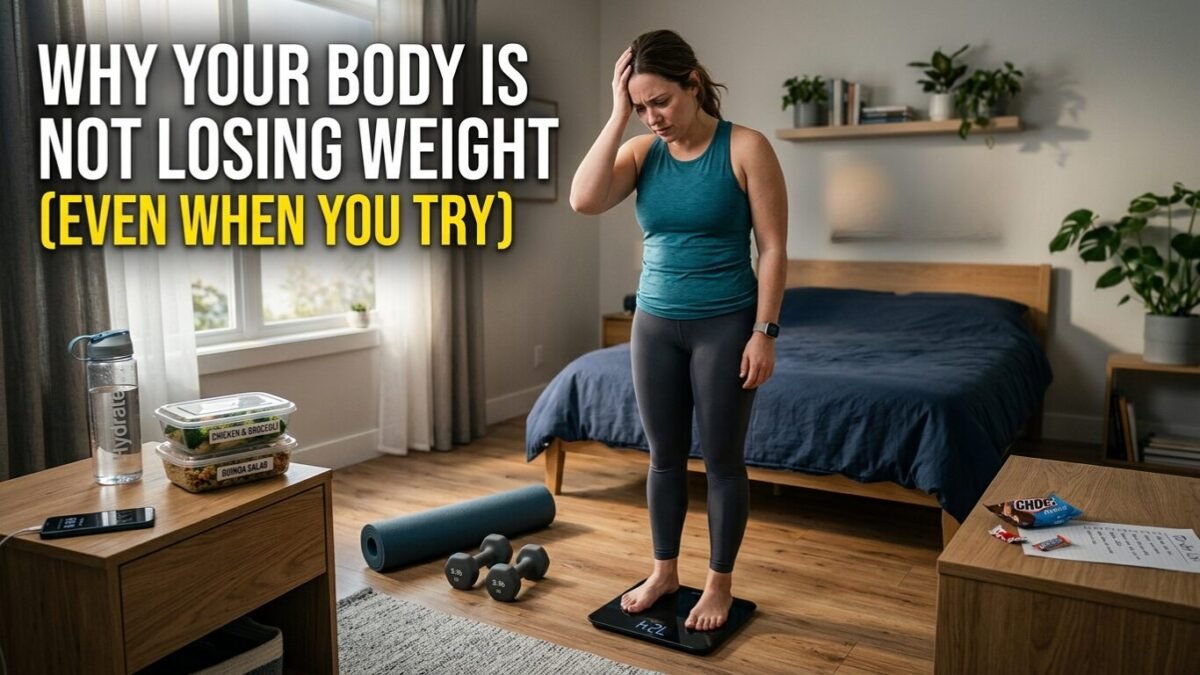
You have been eating better. You have been going to the gym. You are drinking more water, skipping the late-night snacks, and trying to stay consistent. But the scale just will not budge.
Sound familiar?
It is one of the most frustrating experiences in fitness doing everything “right” and still seeing no results. And the worst part? A lot of the time, the problem is not your willpower or effort. It is something quieter, something happening under the surface that most people never think to check.
Let us talk about why your body is not losing weight, and what is actually going on.
You Might Be Eating Less, But Not Eating Right
One of the first things people do when they want to lose weight is cut calories. And while a calorie deficit is genuinely important, the type of food you are eating matters just as much.
For example, 400 calories of white rice with no protein will affect your body very differently than 400 calories of grilled chicken with vegetables. The first spikes your blood sugar, leaves you hungry again in two hours, and does little to protect your muscle mass. The second keeps you fuller longer, supports metabolism, and actually helps your body burn fat more efficiently.
If you are not losing weight despite exercise, take a closer look at your food quality not just the numbers.
Some foods that often slow progress without people realising:
- Flavoured yoghurts and “low-fat” packaged snacks (usually loaded with sugar)
- Fruit juices and smoothies (more calories than expected, minimal fibre)
- Salad dressings and sauces (easy to underestimate)
- Protein bars that are really just candy bars with added protein powder
This does not mean you need to eat perfectly every day. But it does mean being a bit more honest about what is actually going in.
Sleep Is Not Optional It Is Part of the Process
A lot of fitness content focuses entirely on food and exercise, but poor sleep might be one of the biggest reasons you are not losing belly fat.
When you are sleep-deprived, your body produces more cortisol (a stress hormone) and ghrelin (the hunger hormone), while producing less leptin (the hormone that signals fullness). In plain terms: you feel hungrier, you crave more high-calorie food, and your body is more likely to store fat instead of burning it.
Getting six hours of sleep while trying to lose weight is like trying to drive with the handbrake on. You can push harder, but progress will always be limited.
If you are consistently getting less than seven hours, that alone could be a major factor.
Stress and Cortisol: The Hidden Weight Loss Blocker
Chronic stress does something sneaky it raises cortisol levels, and consistently high cortisol is directly linked to fat storage, especially around the belly. This is why some people with healthy habits but no weight loss find that their midsection is the last to change.
Stress triggers the body’s survival mode. From your body’s perspective, stress means danger, and fat is stored energy it might need later. So even if you are in a calorie deficit, elevated cortisol can work against fat loss by influencing where and how your body stores and releases energy.
Managing stress is not just a “mental health” tip. It is a fat loss strategy.
Exercise Mistakes That Are Silently Slowing Your Progress
Exercise is essential but more is not always better, and the kind of exercise matters too.
Here are some common fitness mistakes slowing weight loss that people rarely talk about:
Doing only cardio. Long cardio sessions can burn calories in the short term, but they do not build muscle, and muscle is what raises your resting metabolism. If you are only running or cycling, consider adding resistance training two to three times a week.
Not recovering properly. Overtraining raises cortisol and causes inflammation. If you are sore all the time and not sleeping well, more gym sessions might actually be making things harder, not easier.
Underestimating rest. Some people feel guilty on rest days, but that is when the body actually repairs and adapts. Skipping recovery consistently can stall fat loss.
Compensating after workouts. Studies have shown that people often eat more after exercise sometimes more than they burned. This is not a willpower issue; it is just a natural hunger response. Being aware of it helps.
Common Mistakes, Why They Cause Problems, and What to Do Instead
| Common Mistake | Why It Causes Problems | Better Alternative |
|---|---|---|
| Skipping meals to cut calories | Slows metabolism, increases hunger hormones, leads to overeating later | Eat smaller, balanced meals throughout the day |
| Only doing cardio | Burns calories short-term but does not build muscle or raise resting metabolism | Combine cardio with 2–3 days of strength training |
| Sleeping less than 7 hours | Disrupts hunger hormones, increases fat storage and cravings | Prioritise consistent sleep treat it as part of your routine |
| Eating “diet” or low-fat packaged foods | Often high in sugar and low in nutrients, cause blood sugar spikes | Choose whole, minimally processed foods most of the time |
| Ignoring stress levels | Chronically high cortisol encourages belly fat storage | Build in recovery days, and include stress-reducing habits |
| Weighing yourself daily | Weight fluctuates by 1- 3 kg daily it misleads and discourages | Check weight weekly at the same time, or track measurements instead |
What Is a Weight Loss Plateau, and Are You In One?
A weight loss plateau happens when your body adapts to the deficit and routine you have created. Essentially, what worked at the start becomes your new normal, and your body adjusts its energy output to match.
Signs you might be in a plateau:
- No change on the scale for three or more weeks despite staying consistent
- Measurements (waist, hips) are also not changing
- You feel tired or less energetic than usual
- Your hunger levels feel different from when you started
This is not failure it is just biology. Your body is very good at adapting. The fix is usually a small adjustment: slightly changing your calorie intake, switching up your workout routine, or adding a short period of eating at maintenance to reset your metabolism.
Slow Metabolism: Real or an Excuse?
Slow metabolism and weight gain do have a real connection, but it is more nuanced than people think.
Your resting metabolic rate the calories you burn just existing is largely determined by your muscle mass, age, hormones, and genetics. As you lose weight, your metabolism naturally slows somewhat because you have less body to maintain. This is normal, and it is one reason why weight loss tends to get harder the further along you are.
But the gap is rarely as big as people assume. A lot of what gets blamed on “slow metabolism” is actually just a combination of slightly underestimating food intake, slightly overestimating calorie burn from exercise, and not enough muscle mass.
Building muscle through strength training is one of the most practical ways to keep your metabolism running well over time.
Tips for Choosing the Right Weight Loss Approach
With so much advice out there, it is easy to jump from one strategy to the next without giving anything time to work. Here are a few things worth thinking about:
Start with the basics before going extreme. Intermittent fasting, keto, and other structured approaches can work well but if you are not sleeping, managing stress, or eating reasonable portions consistently, the advanced strategy will not fix the foundation.
Match your approach to your lifestyle. A plan that requires you to prep meals for two hours every Sunday only works if you actually have that Sunday. If it does not fit your real life, it will not stick.
Give changes time to show results. Most people abandon something after two weeks if they do not see changes. Fat loss, especially if done sustainably, often takes four to six weeks before it becomes visually noticeable.
Track something other than just weight. Energy levels, sleep quality, how your clothes fit, and strength in the gym are all meaningful indicators of progress even when the scale is being stubborn.
Consider what you are actually able to maintain. This is where a lot of people get stuck. A strategy that gives you fast results but makes you miserable is not a long-term solution. Readers who spend time with communities like Health Fitnesses often find that the most effective approach is the one you can actually keep doing consistently not the one that sounds most impressive.
The Bigger Picture
Reasons you are not losing weight are rarely just one thing. It is usually a combination a bit of sleep disruption, some hidden stress, eating habits that look healthy but are not quite dialled in, and exercise that is not quite matched to the goal.
The good news is that once you start addressing these things one at a time, progress tends to follow. Not always quickly, and not always the way you expected but it happens.
Weight loss is not a straight line. Bodies are complicated and they respond to more than just calories and steps. Being patient with yourself while also being honest about what might need to change is the most realistic path forward.
Wrapping Up
If you are doing the work and not seeing results, you are not broken. You are just missing a piece of the puzzle and now you have a better idea of what to look for.
Start simple. Sleep more. Manage your stress. Look honestly at your food choices. Mix up your exercise. And give yourself enough time to actually see what is working. Consistency over months will always outperform