
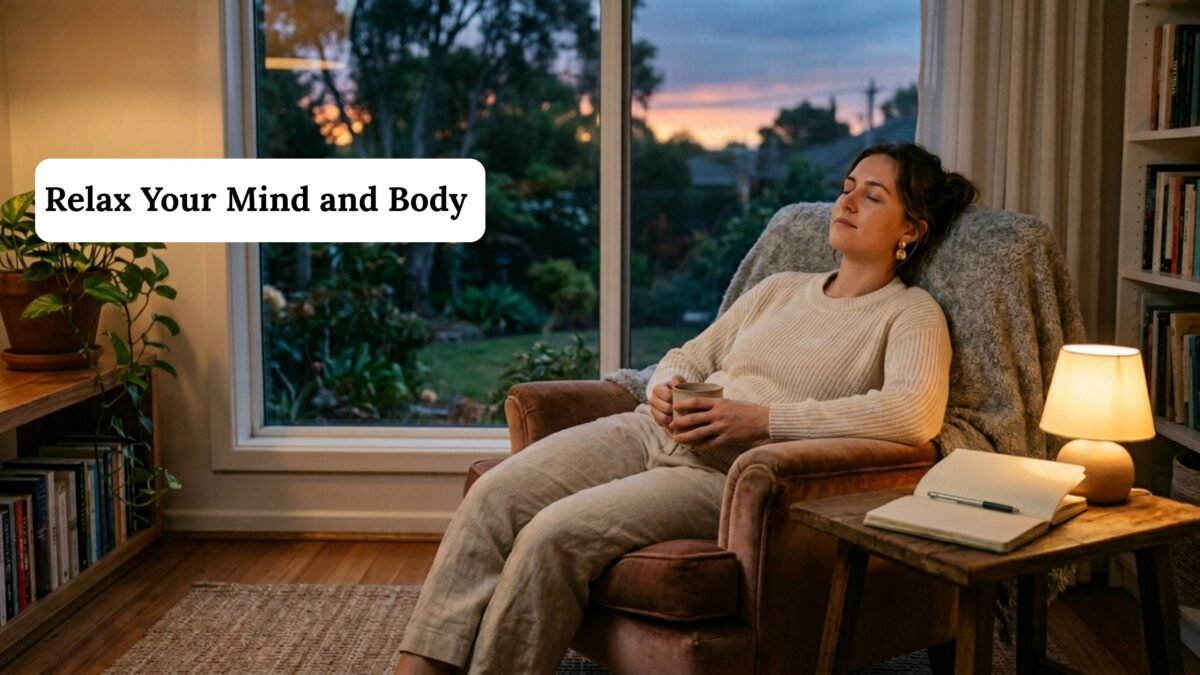
General educational information. This article does not provide a diagnosis or a personal treatment plan. No medical review is claimed. Our medical review policy.
That Actually Work
Have you ever experienced that when you go home after a long tiring day only to have your brain not shutting off? Your body is so, so tired but your mind is still playing the meeting in the afternoon, the texts that were left unsent, the shopping list you forgot. You sleep and not resting, you begin to worry about tomorrow.
This is a feeling, which is known to most of us.
The bad news is that you do not need to learn to relax your mind and body in a complex and time consuming manner. You do not require a spa vacation or two-week vacation. What you require are some truthful, practical plans which can be adapted to your real life - the sort that are effective even when you are tired, even when you are in a state of despair and even when you have only ten minutes left.
This manual takes you through just that.
________________________________________
The reason why Relaxation is more than doing nothing.
Many believe relaxation to be sitting on the couch and scrolling through the phone. However, that is no rest. Actually, passive screen time can actually make you more mentally exhausted than ever.
Real relaxation involves giving the nervous system the opportunity to stop being in the fight-or-flight state and to relax in a more relaxed mode. Stress accumulates without being relieved and this is not only going to impact on your mood. It influences your sleep, your digestion, your immune system as well as your relationships.
Knowing how to relax your body is an art - and any art, like any other, is acquired by practice.
________________________________________
Easy to follow tips on how to calm your mind and body on a daily basis.
Breathing: Like You Mean It.
This barely comes too simple, yet deliberate and slow breathing is among the quickest methods of calming your nerves. Breathing is shallow, quick, when you are under stress. This warning is to your brain, which sustains the stress reaction.
It is easy to reverse such signal. Practise: breathe in four counts, pause four, out six. The extended breath triggers the parasympathetic nervous system, the natural state of your body, namely, rest and digest.
Just do this two minutes, and the majority of people can feel a tangible change. It doesn’t require any equipment, it doesn’t need a costly office or a bathroom stall, it can be done anywhere, and even better, it is free.
2. Get Your Body Moving to Calm Your mind.
It is no wonder people say that they can think better after a walk. Exercise aids in breaking down stress hormones in the body such as cortisol and adrenaline that accumulate in the body during stressful experiences. When those hormones fail to be released, they remain in your system, and leave you feeling tense.
You do not have to go to the gym or have an exercise plan. A fifteen minutes walk outside, a little stretching at your desk or dancing in your kitchen will help keep your body, and thoughts on the ground.
The trick is to be consistent. Exercising your body every day, but not intensely, will teach your mind to be relaxed in all circumstances since you are actively providing your body with a physical release of stress.
3. Experiment with Progressive Muscle Relaxation.
The method is underestimated and is particularly effective among individuals who bear tension on their shoulders, jaw or lower back without their awareness.
Progressive muscle relaxation operates through the tightening of each one of the muscles sequentially, but it is kept tight just a few seconds and then is released. You begin at your feet and move upwards to your face. Tension and release are a lesson to your body of what the practice of letting go physically is like.
Most individuals find out that they have been tightening their teeth or tightening their stomach all through the day. The habit will enable you to be more conscious of the area in which you experience stress and provide you a path way through which you can easily relieve the stress.
4. Secure Your sleep environment.
It is during the time of sleep that your brain literally cleanses itself. In deep sleep your brain cleanses itself by the glymphatic system of waste products, which are directly linked to mental sanity and control of emotions.
In case you have trouble unwinding your brain at night, then you could be living in a hostile environment. Some sincere readjustments will be a difference:
• Make your bedroom cool (65 to 68 degrees Fahrenheit is generally a good temperature that most people will feel comfortable working with)
• Reduce the amount of light at least 1 hour before sleep.
• Place your cell phone on the other side of the room or on the other side of the room altogether.
• Have a regular bedtime, including weekends.
It sounds boring. It works.
Even a Little bit of Time in Nature.
Studies have always indicated that going outside, particularly by trees or water, has the ability to decrease cortisol levels and slow brain activity in the rumination-related part of the brain. This practice is known as shinrin-yoku or forest bathing by the Japanese and does not need a forest.
It can be hard to relax in an open window with a view of an open window and a garden, or even sitting on the park bench, but this will help you relax when the walls seem to be closing in on you. Something natural light, natural sounds, and lack of notifications enable the brain to loosen its hold on the worry.
________________________________________
So, What to Do to Soothe Your Nervous System When Stress Strikes.
Relaxation is not always in a way that one gets to calm down at the end of the day. Stress can occur out of the blue at times: a bad phone call, bad news, an uncomfortable confrontation, etc. and you must be able to put your nervous system into an emergency shutdown to handle the stress.
The following are three quick things:
Cold to your face or your wrists. This triggers the dive reflex, a physiological reaction which makes your heart beat nearly immediately slower. It is strange, but it is really beneficial.
Basing on your senses. List five things that you can see, four things you can touch, three things you can hear, two things you can smell, and one thing you can taste. This will take your mind off of anxiety thoughts and into the present.
Mumbling or soft singing. Vagus nerve, one of the key nerves that control your body in response to stress, runs through the throat. It can be aroused by humming, singing or even sighing aloud and can help to relax your brain in times of acute stress.
________________________________________
Suggestions on how to select the correct method of relaxation.
Not all the techniques are effective with all individuals. Deep breathing can be very soothing to some, aggravating to others. There are those who adore yoga and there are those who find it boring. The idea is to discover what will really benefit you, rather than what will appear well on a checklist of wellness.
The following are some of the questions to assist you in coming up with that:
What is the main part of your body that experiences tension (or your mind)? In case it is physical (tight muscles, headaches, shallow breathing), the initial step is the movement or progressive muscle relaxation. In case it is mental (racing thoughts, anxiety, overthinking), focus on breathwork, time in nature or journaling.
• What do you think you have in terms of time? Two minutes of breathing is more effective than a half-an-hour meditation that you will never do.
• Do you like to relax alone or with someone? There are individuals who relax well on their own. Others require association - a chat with a friend or laughing with relatives or even working out together.
• What did you do that was really good? Start there. Make on what you have known to work.
________________________________________
Comparison of the most common relaxation techniques in a practical manner.
Technique Most suitable time required-cost.
Deep Breathing Relaxation in a hurry, everywhere 2-5 minutes free.
Progressive Muscle Relaxation Physical tension, sleeping difficulty 10-20 minutesFree.
Light Exercise or Walk Mental fatigue, mood lifter 15 to 30 minutes Free.
Nature Time Chronic stress, overstimulation 15-60 minutes Free.
Journaling Anxiety, overthinking 10 to 15 minutes Minimal
Meditation or Guided Audio Deep relaxation, mind training 10-30 minutes Free-low cost.
Cold Water Technique Panic stress, acute situations 30 to 2 minutes free.
________________________________________
The book The Building of a Habit: How to Train Your mind to be calm in any situation was used.
The most feasible change you can make is to consider relaxation as routine and not a resort last resort. When you just attempt to calm down after you have reached your limit, it is like attempting to drink water once you have fallen on the ground due to lack of water.
A little, regular routine develops what some scientists term, stress resilience - your nervous system becomes more adaptable and gets out of stress more quickly.
Something caught my attention a couple of years ago when a writer at Health Fitnesses wrote it. She even said that she experienced a time of burnout to the extent that she could not get more than four-hour sleep in a day. What was of assistance to her was not a radical change--it was five minutes of breathing in the morning and a fifteen minutes walk after dinner. There was an improvement in her sleep in more than six weeks. Her anxiety reduced. Instead, she laid a foundation and not everything was done in a single night.
That is the actual aim of this not of perfection, but of a constant, individual practice, which you can revert to.
________________________________________
The 10 Best Tips to Relax Your Body When You’re Running on Empty
With fatigue and stress comprising one on top of the other, even simple self-care may seem unattainable. On such days make it simple.
Start small. Take a drink of water. Breath in, three times. Spend five minutes (without your phone) sitting somewhere comfortable. They are not cures, but they interrupt the tension cycle sufficiently, so that your body can start to heal.
It also assists in observing what aggravates things. That, to most people, involves too much caffeine, lack of sleep, too much sitting, over use of social media and holding on to emotions. It can be of great significance to reduce at least one of those factors and decrease the level of stress that your body is bearing.
It is not necessarily, what can I add? At times it can be what can I take away.
________________________________________
The moral of the story: Your Body Is Always Trying to tell you something.
Training to get your mind and body to relax is not a luxury, but maintenance. Just like you would never run your automobile without ever filling up her tank, you can never expect your brain and your body to continue to operate without frequent rest and recovery.
The techniques in the article are no magic. But they are sincere, supported by solid knowledge of bodily functioning and most of them are free. You can use the tools to help you relax your nervous system when you are in a crisis or in other situations that require you to be more resilient in the long-term.
Start with one. Faith it this week. Be conscious of your feeling. then commence on that.
You do not have to be calm all the time; all the days. All you should know is how to get back when the going gets tough.