
General educational information. This article does not provide a diagnosis or a personal treatment plan. No medical review is claimed. Our medical review policy.
Why You Can't Ignore Either
There was a period in my life maybe two or three years ago when I genuinely believed I was "managing fine." I was eating okay (or so I told myself), sleeping about six hours a night, skipping workouts because work was busy, and telling everyone I was just stressed but handling it.
I wasn't handling it.
What I thought was just stress had quietly turned into mood swings I couldn't explain, brain fog that made simple tasks feel exhausting, and a low-grade sadness I kept brushing off as "just life." It took a conversation with a doctor friend and honestly, a lot of reading on Health Fitnesses to realize something I hadn't connected before: my body and my emotions weren't two separate things. They were talking to each other constantly, and I'd stopped listening.
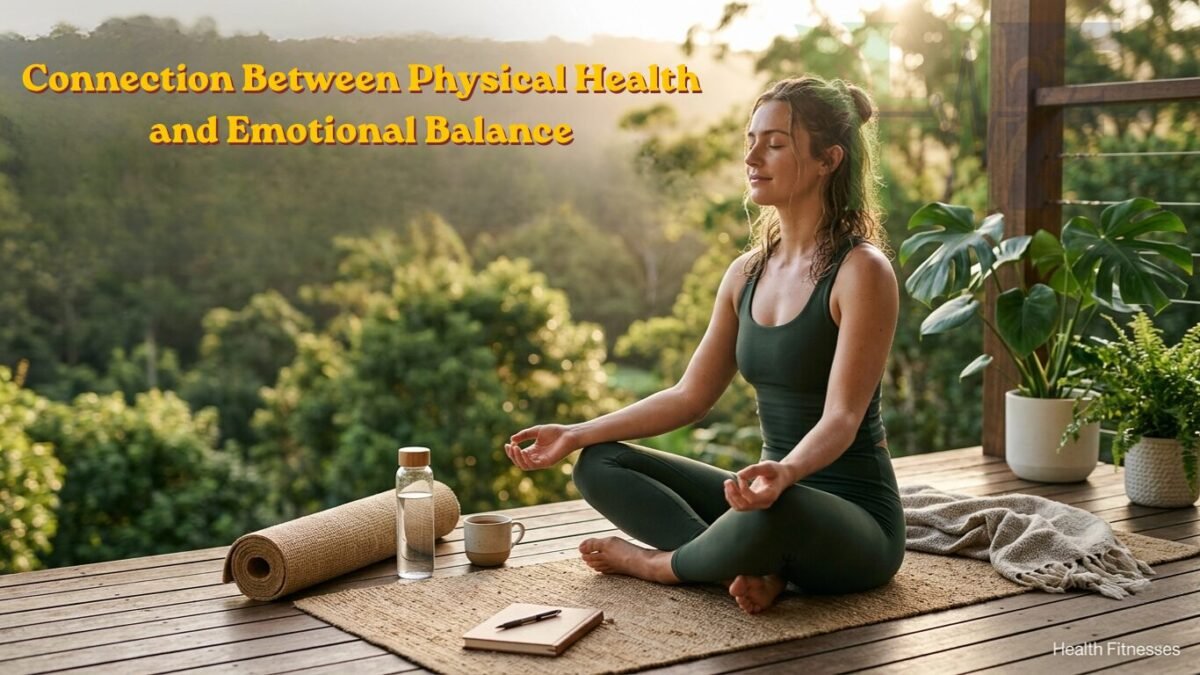
The connection between physical health and emotional balance is one of those things that sounds obvious once someone says it out loud, but somehow we still manage to live like it isn't true.
Why Your Body and Emotions Are Always in Conversation
Here's something worth sitting with: your body doesn't separate "physical" from "emotional." That's just a label humans created to organize things. Inside you, everything is wired together.
When you're physically depleted whether from poor sleep, a bad diet, or barely moving your body your nervous system picks up on it. Your cortisol creeps up. Your dopamine dips. Your serotonin production, which is heavily influenced by gut health, starts to wobble. And suddenly, you're not just tired. You're irritable. You're anxious. You feel emotionally raw in ways that don't quite make sense.
That's not weakness. That's biology.
The research backs this up consistently. Regular physical activity has been shown to reduce symptoms of depression and anxiety, sometimes as effectively as medication in mild-to-moderate cases. Gut bacteria shaped largely by what you eat influence neurotransmitter production. Sleep deprivation measurably increases emotional reactivity. These aren't just wellness buzzwords. This is your actual nervous system, responding to how you're treating your body.
How Physical Health Affects Emotional Well-Being (More Than You'd Expect)
Most people understand the surface connection exercise makes you feel good, junk food makes you sluggish. But it goes deeper than that, and it's worth understanding how these systems interact.
Sleep: The Thing Nobody Takes Seriously Enough
Sleep is probably the single most underrated factor in emotional balance. When you're chronically under-slept, your prefrontal cortex the part of your brain that helps you regulate emotions, make rational decisions, and keep perspective basically goes offline. What takes over? The amygdala. The reactive, threat-detecting, emotionally volatile part.
That's why everything feels harder after a bad night's sleep. You're not being dramatic. You're literally running on a compromised brain.
Movement and Mental Clarity
Exercise releases endorphins, yes but it also promotes neurogenesis (the growth of new brain cells), reduces inflammation, and improves the brain's ability to handle stress. People who move regularly tend to report higher mental clarity, better mood stability, and a more grounded sense of self.
And you don't need to be training for a marathon. A 30-minute walk most days is genuinely meaningful for your emotional well-being. I've had some of my most emotionally clarifying moments on nothing more than a walk around the neighborhood with my headphones off.
Nutrition and Your Emotional State
The gut-brain axis is real and it's fascinating. Roughly 90% of your serotonin often called the "feel good" neurotransmitter is produced in your gut. What you eat directly influences your gut microbiome, which influences that production. Ultra-processed foods, excess sugar, and chronic dehydration all contribute to inflammation, which has been consistently linked to depressive symptoms.
None of this means food is medicine in some magical way. But it does mean that what you eat is part of how you feel. Emotionally.
The Connection Between Physical Health and Emotional Balance: A Practical Look
Let's make this a little more concrete. Here's a simple comparison that illustrates what shifts when physical habits change:
| Area of Life | When Physical Health Is Neglected | When Physical Health Is Prioritized |
|---|---|---|
| Mood | Frequent irritability, low motivation | More stable, resilient mood day-to-day |
| Stress Response | Overwhelmed quickly, slow to recover | Better stress tolerance, faster recovery |
| Mental Clarity | Brain fog, difficulty concentrating | Sharper focus, clearer thinking |
| Emotional Reactions | Disproportionate or unpredictable | More measured and grounded |
| Energy | Crashes, reliance on caffeine | Steadier energy throughout the day |
| Self-Perception | Negative self-talk, low confidence | Improved self-worth and body image |
This isn't about being perfect. It's about recognizing that neglecting the physical side of life has real emotional consequences ones that often get mislabeled as personality flaws or mental health crises when they're actually lifestyle signals.
Self-Care Habits That Actually Support Emotional Balance
Self-care gets a bad rap sometimes it's been turned into a marketing concept involving bath bombs and scented candles. Real self-care is more boring and more powerful than that. It's the unglamorous stuff you do consistently.
Here are the habits that genuinely move the needle on emotional well-being:
- Consistent sleep and wake times Your circadian rhythm regulates hormones that affect mood. Keeping it stable matters more than most people realize.
- Daily movement, even gentle movement Walking, stretching, yoga, dancing in your kitchen. Whatever gets you out of stillness.
- Eating meals with some intention Not diet culture, not restriction. Just including vegetables, protein, and enough water most of the time.
- Spending time outside Natural light, fresh air, and contact with nature have measurable effects on emotional regulation.
- Limiting alcohol Alcohol is a depressant. Many people use it to manage stress and end up with more emotional instability as a result.
- Some form of stillness practice Meditation, journaling, prayer, quiet walks. Something that lets your nervous system downshift.
- Social connection Real connection, not just scrolling through what other people are doing. Time with people who actually know you.
Tips for Choosing the Right Method to Improve Emotional Balance Naturally
This is where I want to be honest with you: not every approach works for every person, and anyone who tells you otherwise is selling something.
Here's how to find what actually fits your life:
- Start with sleep before anything else. If your sleep is chaotic, everything else you try will be working uphill. Address sleep first, even if it's just moving bedtime 30 minutes earlier.
- Pick movement you don't hate. Exercise you avoid isn't useful. Walk if you like walking. Swim if you like swimming. The best workout is the one you'll actually do.
- Don't overhaul everything at once. Pick one thing. Do it for three weeks. Then add something else. Wholesale lifestyle changes rarely stick small, layered habits do.
- Pay attention to how food makes you feel after eating it, not just in the moment. Notice energy levels, mood shifts, and digestion. That data is personal and valuable.
- Give habits time to show results. Emotional shifts from lifestyle changes don't happen in a week. Give yourself at least four to six weeks before deciding something isn't working.
- Be honest about stress sources. Sometimes the barrier to emotional balance isn't about adding good habits it's about removing something draining: a toxic dynamic, a job that's eating you alive, or commitments you never wanted.
- Consider professional support alongside lifestyle changes. Therapy and physical health improvements work well together. One doesn't replace the other.
Building a Healthy Routine That Holds
One thing I've learned and this took me longer than it should have is that a healthy routine doesn't have to be rigid to be real. It just has to be honest.
Some mornings you get eight hours and a good breakfast and a workout. Some mornings you're running late and surviving on coffee. Both are normal. What matters is whether, on balance, over weeks and months, you're doing enough of the good stuff to actually feel it.
A wellness lifestyle isn't a checklist you hit every day. It's a direction you're moving in, with room for real life along the way.
When I started taking the physical side of my health more seriously not obsessively, just intentionally I noticed something unexpected. The emotional heaviness I'd been carrying didn't disappear overnight, but it started to feel more manageable. Things that used to spiral into hours of anxiety started resolving in minutes. I could sit with discomfort without immediately needing to escape it. I felt, weirdly, more like myself.
That's what the connection between physical health and emotional balance actually looks like in practice. It's not dramatic. It's quiet and cumulative.
The Part Nobody Talks About: Emotional Health Affects Your Body Too
This works both ways, and it's worth saying.
Chronic stress raises cortisol, which over time affects immune function, digestive health, sleep quality, and cardiovascular health. Suppressed grief and unprocessed trauma can manifest as physical symptoms chronic tension, fatigue, gut issues, headaches. Your emotional state is constantly communicating with your body, just as your body communicates with your emotions.
This is why pure physical approaches only go so far. You can optimize sleep and diet and exercise and still feel off if you're carrying unresolved emotional weight. The system is integrated. It asks for integrated care.
Bringing It Back to You
There's something quietly hopeful about understanding how deeply connected physical and emotional health really are. It means that when you take care of one, you're almost always helping the other. A walk helps your mood. Processing your emotions helps your digestion. Better sleep helps your resilience. Better resilience helps your sleep.
The connection between physical health and emotional balance isn't a theory to understand it's a lived reality you can actually feel, if you start paying attention.
If you've been struggling emotionally and you can't quite figure out why, it might be worth looking at the physical side of things first. Not because emotions aren't real or valid. But because sometimes the most compassionate thing you can do for your inner world is take care of the body it lives in.
That's not a small thing. That's actually everything.