
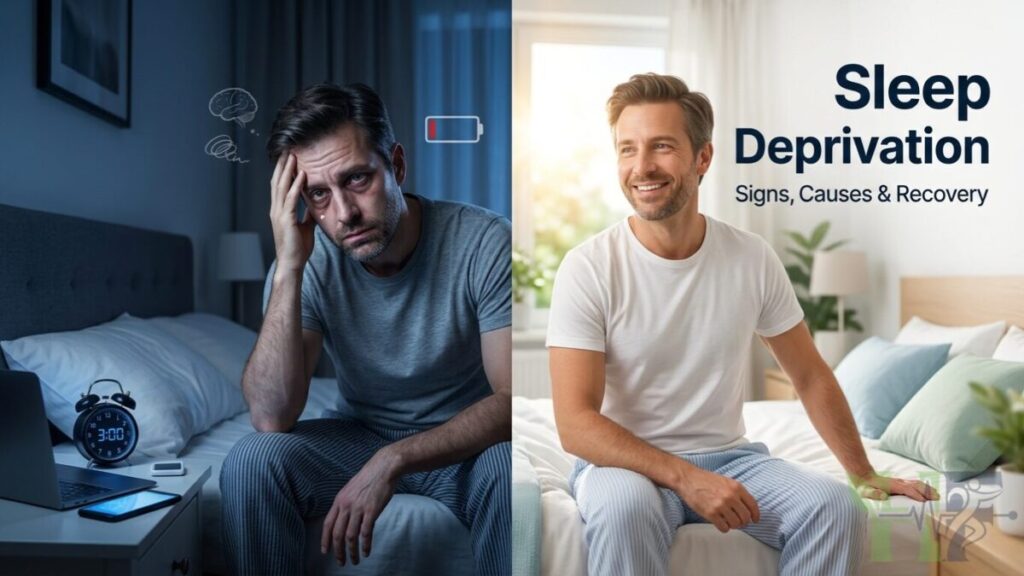
What It’s Really Doing to Your Body, Brain, and Life
Most people have had a rough night or two. You lie awake with a racing mind, finally drift off around 3 a.m., and then drag yourself through the next day on caffeine and willpower. That feels miserable enough. But when those rough nights become the rule rather than the exception, something far more serious is unfolding and most people don’t recognize it until the damage is already done.
Sleep deprivation isn’t just about feeling tired. It’s a physiological state that quietly disrupts nearly every system in your body. Your immune defenses weaken. Your hormones shift. Your brain starts cutting corners. And yet, in a culture that often treats exhaustion as a badge of productivity, millions of adults keep pushing through without ever connecting the dots between how they feel and how little they sleep.
This article is about those connections the ones your body is already making, whether you’re paying attention or not.
What Is Sleep Deprivation, Really?
At its simplest, sleep deprivation occurs when a person gets less sleep than their body needs to function properly. For most adults, that means consistently sleeping fewer than seven hours a night. But the definition gets more nuanced when you factor in sleep quality. You can spend eight hours in bed and still experience sleep deprivation if that time is fragmented, shallow, or interrupted.
There’s an important distinction between occasional and chronic sleep deprivation. Pulling one late night before a deadline? That’s occasional. Your body is designed to handle short-term disruptions you feel rough the next day, sleep longer the following night, and recover. Chronic sleep deprivation is a different story. That’s when insufficient sleep becomes a sustained pattern over weeks, months, or even years. The body adapts to feeling exhausted in ways that make the problem harder to detect from the inside, even as it quietly accumulates real physiological consequences.
Many readers at Health Fitnesses are surprised to discover that even a few nights of poor sleep can noticeably affect mood, concentration, and energy levels and that those effects compound quickly when sleep debt builds up.
Why Sleep Is Far More Active Than You Think
Sleep isn’t passive rest. While you’re unconscious, your brain and body are running through a series of precisely choreographed processes that cannot be replicated while you’re awake.
The Sleep Cycle
A full night of healthy sleep moves through multiple cycles, each lasting roughly 90 minutes. Within each cycle, you pass through lighter sleep stages, deep slow-wave sleep, and REM (rapid eye movement) sleep. Deep sleep is when the body does its most intensive physical repair releasing growth hormone, consolidating immune function, and restoring cellular damage. REM sleep is when the brain processes emotions, consolidates memories, and clears metabolic waste through the glymphatic system.
Shortening sleep doesn’t just mean less rest. It means fewer complete cycles, which disproportionately cuts into the deep and REM stages that do the heaviest lifting. This is why someone who sleeps five hours doesn’t just feel 37% worse than someone who slept eight they often feel dramatically worse than the math would suggest.
Common Causes of Sleep Deprivation
Sleep problems rarely have a single cause. More often, they’re the product of overlapping habits, circumstances, and conditions that quietly erode sleep over time.
Stress and sleep have a deeply circular relationship. Stress elevates cortisol and keeps the nervous system in a state of alertness that makes falling asleep difficult. Poor sleep then raises stress hormones further, making the next night harder. Many people find themselves locked in this loop without realizing the two problems are feeding each other.
Insomnia is one of the most prevalent sleep disorders globally, affecting the ability to fall asleep, stay asleep, or both. It can be triggered by anxiety, depression, medication, pain, or simply ingrained behavioral patterns around sleep.
Technology use before bed is a more modern culprit. Blue light from screens suppresses melatonin production, the hormone that signals to your body that it’s time to sleep. Scrolling through a phone in a dark room is essentially telling your brain it’s midday.
Poor bedtime routines or no routine at all also play a role. The body relies on consistent cues to initiate the sleep process. Irregular sleep schedules confuse the circadian rhythm, making it harder to fall asleep at a consistent time.
Other factors include heavy alcohol use (which fragments sleep architecture even if it helps you fall asleep initially), excessive caffeine intake in the afternoon, shift work, and underlying conditions like sleep apnea, restless legs syndrome, or chronic pain.
Recognizing Sleep Deprivation Symptoms
Some signs of sleep deprivation are obvious. Others creep up so gradually that people mistake them for personality traits or age-related changes.
- Fatigue and low energy that doesn’t resolve after a night of slightly better sleep
- Brain fog a heavy, clouded feeling that makes thinking feel like pushing through wet cement
- Concentration problems and an inability to stay focused on tasks that should be simple
- Mood changes irritability, emotional reactivity, a shorter fuse than usual
- Memory issues, particularly with short-term recall and retaining new information
- Slowed reaction times that affect everything from driving to catching a dropped cup
- Increased appetite, especially for high-calorie, carbohydrate-rich foods
The last one surprises many people. Sleep deprivation elevates ghrelin (the hunger hormone) and suppresses leptin (the satiety hormone), which is why exhausted people often reach for cookies at 3 p.m. and don’t understand why.
Effects of Sleep Deprivation on the Body
Immune System
During deep sleep, the body produces cytokines proteins that help fight infection and inflammation. Chronic sleep deprivation reduces cytokine production, leaving you more vulnerable to illness and slowing recovery when you do get sick. Research has shown that people who sleep fewer than six hours a night are significantly more likely to catch a common cold when exposed to the virus.
Heart Health
Consistently short sleep is associated with elevated blood pressure, increased inflammation, and higher risk of cardiovascular disease. The heart doesn’t get adequate recovery time when sleep is cut short, and stress hormones that remain elevated during sleepless nights add further strain over time.
Weight Management
Beyond the hormonal appetite disruption mentioned above, sleep deprivation reduces insulin sensitivity, meaning the body becomes less efficient at processing glucose. This can contribute to weight gain and increases the long-term risk of type 2 diabetes.
Hormonal Balance
Growth hormone, testosterone, cortisol, thyroid hormones, and reproductive hormones are all regulated in part by sleep. Disrupting sleep disrupts this hormonal orchestra, with downstream effects on energy, metabolism, muscle recovery, and reproductive health.
Sleep Deprivation and Mental Health
The relationship between sleep and mental health runs in both directions. Poor sleep contributes to anxiety and depression, and anxiety and depression make sleep harder to come by.
What’s worth understanding is that sleep deprivation doesn’t just make an existing mood disorder worse it can actually precipitate one in people who were previously well. Even in otherwise healthy individuals, a sustained period of insufficient sleep produces symptoms that mirror clinical anxiety: hypervigilance, catastrophic thinking, emotional dysregulation, and difficulty calming down.
The brain’s amygdala the region responsible for processing threat and fear becomes significantly more reactive after sleep loss. Meanwhile, the prefrontal cortex, which normally acts as a brake on emotional responses, becomes less effective. The result is that sleepy people aren’t just grumpier. They’re neurologically less capable of regulating their emotions.
Sleep Deprivation and Brain Function
Focus and Productivity
The prefrontal cortex is the last area of the brain to recover from sleep loss and the first to degrade. This is the region responsible for executive function attention, planning, impulse control, and complex reasoning. Even moderate sleep deprivation has measurable effects on cognitive performance comparable in some studies to being legally drunk.
Learning and Memory
The hippocampus consolidates new information during sleep, particularly during REM. Without adequate sleep, the brain’s ability to form new memories and transfer them to long-term storage is genuinely compromised. Students pulling all-nighters before exams are, in a real sense, undermining the very process they’re trying to accelerate.
Decision-Making
Sleep-deprived people tend to take more risks, make more impulsive choices, and show reduced sensitivity to consequences. This isn’t a character flaw it’s neuroscience. The circuits that evaluate risk and reward function differently when sleep debt is present.
Advantages of Proper Sleep vs. Health Risks of Sleep Deprivation
| Factor | With Adequate Sleep | With Sleep Deprivation |
| Energy levels | Stable throughout the day | Crashes, reliance on stimulants |
| Immune function | Strong cytokine production | Weakened, slower recovery |
| Mood | Generally stable and regulated | Irritable, emotionally reactive |
| Cognitive performance | Sharp focus, clear memory | Brain fog, poor retention |
| Weight regulation | Balanced hunger hormones | Increased cravings, insulin resistance |
| Heart health | Lower inflammation, normal BP | Elevated cardiovascular risk |
| Mental health | Emotional resilience | Heightened anxiety, low mood |
How to Recover From Sleep Deprivation
Recovery from occasional sleep debt is straightforward you sleep more, and your body catches up. But chronic sleep deprivation requires a more deliberate approach.
- Prioritize consistency over quantity at first. Going to bed and waking at the same time every day, including weekends, resets the circadian rhythm more effectively than trying to sleep in on Sundays.
- Reduce sleep debt gradually. Adding 30 to 60 minutes per night over a week or two is more sustainable than trying to sleep 10 hours for a few nights.
- Address the underlying cause. If stress is driving poor sleep, stress management must be part of the solution. If insomnia is structural, behavioral techniques like Cognitive Behavioral Therapy for Insomnia (CBT-I) have strong evidence behind them.
- Protect daytime energy without compensating with naps. Long naps can interfere with nighttime sleep pressure. If napping, keep it under 20 minutes and before 3 p.m.
- Be patient with cognitive recovery. Memory and complex reasoning take longer to bounce back than basic energy levels. Give it time.
Natural Ways to Sleep Better
Sleep quality can improve significantly through behavioral and environmental changes alone, without medication.
- Limit caffeine after midday. Caffeine has a half-life of five to seven hours, meaning half of a 3 p.m. coffee is still active in your system at 9 p.m.
- Create a cooling environment. Core body temperature drops during sleep initiation. A cooler bedroom around 65 to 68°F for most adults supports this process.
- Get morning light exposure. Natural light in the first hour after waking anchors the circadian rhythm and improves sleep timing at night.
- Limit alcohol within three hours of bed. Even moderate amounts disrupt the sleep architecture, reducing the percentage of restorative REM sleep.
- Manage evening screen exposure. Use blue light filters or switch to warmer light sources in the two hours before bed.
How to Improve Sleep Quality Naturally
Beyond the basics, some less obvious strategies can meaningfully improve how deeply and consistently you sleep.
Regular physical exercise improves sleep quality but timing matters. Exercise raises core temperature and cortisol, so vigorous workouts within two to three hours of bedtime can interfere with sleep initiation for some people.
Magnesium (found in nuts, seeds, leafy greens, and legumes) plays a role in GABA regulation, the neurotransmitter that promotes relaxation. Dietary deficiency is common and can contribute to sleep difficulties.
Journaling before bed particularly writing down tomorrow’s to-do list has been shown in research to reduce presleep cognitive arousal. Essentially, getting thoughts out of your head and onto paper reduces the mental loop that keeps many people awake.
Breath-focused relaxation, including techniques like diaphragmatic breathing or progressive muscle relaxation, activates the parasympathetic nervous system and can meaningfully shorten the time it takes to fall asleep.
Practical Tips for Better Sleep Every Day
Small, consistent habits are what actually shift sleep quality over time. Here are actionable steps to start building a genuinely better sleep routine:
- Set a fixed wake time and keep it every day, regardless of how the night went.
- Spend 10 minutes outside in natural light within an hour of waking.
- Avoid looking at your phone for the first 30 minutes after waking.
- Move your body daily even a 20-minute walk improves sleep quality.
- Eat dinner at least two to three hours before your intended bedtime.
- Dim indoor lights an hour before bed to support melatonin rise.
- Keep the bedroom reserved for sleep and sex only no working or scrolling in bed.
- Create a short, consistent wind-down ritual: stretching, light reading, or a warm shower.
- Write down three things you need to do tomorrow before closing the laptop for the night.
- If you wake in the night and can’t fall back asleep after 20 minutes, get up and do something calm until you feel sleepy again rather than lying awake in frustration.
When to Seek Professional Help
Self-help strategies work well for many people, but there are situations where professional evaluation is necessary.
If you’ve genuinely prioritized sleep for several weeks and still wake unrefreshed, struggle with excessive daytime sleepiness, snore heavily, or frequently wake gasping, it’s worth talking to a doctor. Sleep apnea is significantly underdiagnosed and has serious cardiovascular implications if left untreated.
Similarly, if insomnia has persisted for more than three months despite behavioral changes, a trained therapist offering CBT-I can address the cognitive and behavioral patterns that are perpetuating the problem more effectively than any supplement or sleep hygiene tip alone.
Sleep deprivation is not a character flaw, and needing help isn’t either.
The thing about sleep is that it’s easy to dismiss when life gets busy, because the consequences don’t announce themselves loudly. They build quietly a little more fatigue, a little more irritability, a little more difficulty thinking clearly until one day you realize you can’t remember the last time you woke up and felt genuinely rested.
That’s the moment worth paying attention to. Not to panic, but to take seriously. Because recovering from sleep deprivation, while not instant, is entirely possible. The body wants to sleep well. Most of the time, it just needs you to stop getting in its way.
Start with one habit. Keep it consistent. Let the rest follow.