How Many Calories Do FIFA World Cup Players Burn in One Match?
Ninety minutes. Two halves. One ball. And beneath the noise of a packed stadium, twenty-two athletes are quietly putting their bodies through one of the most demanding physical tests in professional sport.
A FIFA World Cup match isn’t just a contest of skill it’s a full-body endurance event that combines sprinting, jumping, tackling, and near-constant motion, all sustained under intense pressure and, often, punishing heat. Fans watching from home rarely stop to consider just how much fuel it takes to run a football match at that level. So how many calories do FIFA World Cup players burn in one match? The answer might surprise you and understanding it reveals a lot about what elite football fitness actually requires.
In this article, we’ll break down the science behind football calorie burn, compare energy expenditure by playing position, and explain exactly how professional athletes fuel and recover from one of the toughest 90 minutes in sport.
How Many Calories Do FIFA World Cup Players Burn in One Match?
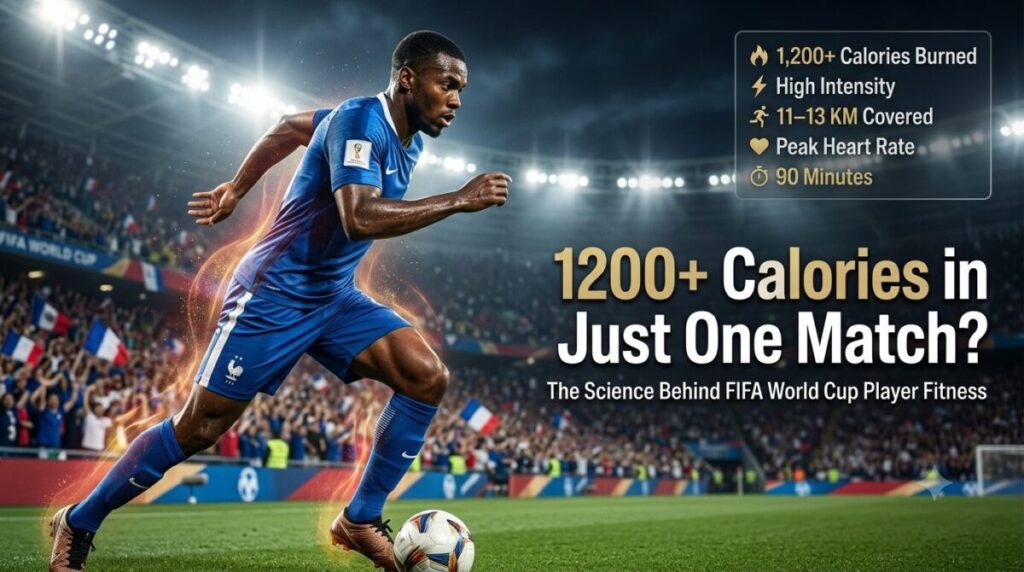
On average, a FIFA World Cup player burns between 900 and 1,500 calories during a single 90-minute match. Midfielders tend to sit at the higher end of that range due to the sheer distance they cover, while goalkeepers burn considerably less because their movement is far less continuous.
That said, there’s no single number that applies to every player. Calorie burn during a football match depends on a combination of factors, including:
- Playing position midfielders and full-backs generally cover more ground than center-backs or goalkeepers
- Match intensity a knockout-stage match played at full throttle burns more energy than a low-tempo group game
- Distance covered total kilometers run throughout the 90 minutes
- Sprint frequency how often a player accelerates into a full sprint versus jogging or walking
- Body weight heavier athletes generally expend more energy performing the same movement
- Muscle mass more active muscle tissue means higher metabolic demand during exertion
- Playing style a high-pressing, transition-heavy system burns significantly more energy than a possession-based, low-block approach
This is why two players in the same match say, a central defender and a box-to-box midfielder can have wildly different calorie counts by the final whistle, even though they played the exact same amount of time.
Why Do FIFA World Cup Players Burn So Many Calories?
Football is unique among team sports because it demands both aerobic endurance and repeated bursts of anaerobic power, often with very little recovery time in between.
The Science of Intermittent High-Intensity Effort
Unlike long-distance running, where the effort is steady and predictable, football requires high-intensity interval movement. A player might jog for 30 seconds, then explode into a sprint to close down an opponent, decelerate suddenly, change direction, and jog again all within the space of a minute. This constant switching between effort levels is metabolically expensive because the body has to repeatedly shift energy systems, drawing on stored glycogen for quick bursts and fat/oxygen metabolism for the steadier periods in between.
Movement Patterns That Drive Energy Expenditure
Several specific actions contribute heavily to football’s calorie-burning demands:
- Sprinting the most energy-costly movement in the game, often repeated 30-50 times per match
- Accelerations and decelerations braking and changing direction place enormous strain on the muscles and require significant energy to control
- Jumping aerial duels for headers recruit large muscle groups explosively
- Tackling and physical duels brief but intense bursts of strength and stability
- Ball control under pressure technical actions performed while fatigued increase overall energy cost
- Mental effort decision-making under pressure raises cortisol and indirectly increases overall energy demand, since cognitive load and physical exertion are closely linked during competitive play
Put together, these actions mean a football match is less like a jog and more like dozens of short, intense workouts stacked back-to-back over 90 minutes which is exactly why football endurance training looks so different from traditional distance-running programs.
Average Distance Covered During a FIFA World Cup Match
Distance covered is one of the clearest indicators of calorie burn, and World Cup-level data consistently shows meaningful differences between positions.
- Midfielders typically cover the most ground, often between 11 and 13 kilometers per match, due to their dual defensive and attacking responsibilities
- Full-backs and wing-backs frequently cover 10 to 12 kilometers, driven by repeated up-and-down sprints along the flank
- Center-backs generally cover less distance around 9 to 10 kilometers but perform more high-force, short-burst actions like jumping and tackling
- Forwards cover roughly 9 to 11 kilometers, with an emphasis on explosive sprints rather than constant running
- Goalkeepers cover the least distance, typically under 5 to 6 kilometers, though their bursts of diving and quick reactions are highly explosive in nature
| Position | Average Distance Covered | Movement Style |
| Midfielder | 11-13 km | Continuous, box-to-box |
| Full-back/Wing-back | 10-12 km | Repeated sprint-recovery cycles |
| Forward | 9-11 km | Explosive, sprint-focused |
| Center-back | 9-10 km | Positional, high-force actions |
| Goalkeeper | 4-6 km | Short bursts, reactive |
Calories Burned by Different Playing Positions
Because distance, sprint frequency, and physical duels vary so much by role, calorie burn varies right alongside them. Here’s a realistic breakdown based on typical World Cup match demands:
| Position | Distance Covered | Estimated Calories Burned | Activity Level |
| Midfielder | 11-13 km | 1,200-1,500 kcal | Very high |
| Full-back/Wing-back | 10-12 km | 1,100-1,400 kcal | High |
| Forward | 9-11 km | 1,000-1,300 kcal | High |
| Center-back | 9-10 km | 900-1,150 kcal | Moderate-high |
| Goalkeeper | 4-6 km | 400-600 kcal | Moderate |
Key takeaway: Midfielders are typically the highest calorie-burners on the pitch, not because they’re the fastest players, but because they’re required to be involved in almost every phase of play defending, transitioning, and attacking for the full 90 minutes.
Factors That Affect Calorie Burn
While position is a major factor, individual and situational variables also shape how many calories a player actually burns on matchday.
- Body weight heavier players burn more calories performing identical movements, since more mass requires more energy to move
- Age metabolic rate and recovery capacity shift with age, subtly affecting energy expenditure and efficiency
- Fitness level highly conditioned athletes often move more efficiently, which can slightly lower the energy cost of the same output
- Match tempo a fast, transition-heavy game burns significantly more energy than a slow, controlled one
- Weather conditions heat and humidity increase the body’s cooling demands, raising overall energy expenditure and dehydration risk
- Tournament stage knockout matches tend to be played at higher intensity than early group-stage fixtures, due to the stakes involved
- Extra time an additional 30 minutes can add several hundred calories to a player’s total match output, often while already fatigued
- Muscle mass more lean muscle tissue increases resting and active metabolic demand
- Metabolism individual metabolic rate, influenced by genetics and training history, affects how efficiently the body converts fuel into usable energy
Understanding these variables is central to sports performance planning it’s why national team nutritionists and conditioning coaches build individualized fueling strategies rather than applying one blanket plan to the entire squad.
How FIFA Players Replace Burned Calories
Burning over 1,000 calories in a single match means elite athletes must approach nutrition with real precision. Sports nutrition at this level isn’t about eating “healthy” in a general sense it’s about timing and targeting specific nutrients around performance demands.
Matchday Meals
Most professional players eat their final full meal 3 to 4 hours before kickoff, focusing on easily digestible carbohydrates paired with moderate protein. Heavy, fat-laden meals are avoided because they slow digestion and can cause sluggishness during play.
Carbohydrate Loading
In the days leading up to a match, players often increase carbohydrate intake to maximize glycogen stores in the muscles and liver. This stored glycogen becomes the primary fuel source for high-intensity sprints and repeated bursts of effort during the game.
Protein Intake
Protein plays a smaller role during the match itself but is critical afterward, supporting muscle repair and adaptation. Many players also consume a moderate amount of protein in pre-match meals to support satiety and muscle maintenance.
Hydration and Electrolytes
Fluid loss through sweat can reach 1 to 2 liters per hour depending on conditions, making hydration and electrolyte replacement (sodium, potassium, magnesium) essential both for performance and to reduce cramping risk.
Recovery Shakes and Meals
Immediately after the final whistle, many players consume a fast-digesting recovery shake combining carbohydrates and protein, followed by a full recovery meal within 1 to 2 hours to replenish glycogen and kickstart muscle repair.
How Elite Footballers Recover After Burning 1,000+ Calories
Burning huge amounts of energy is only half the equation recovery determines whether a player is ready to perform again in a few days, which is especially critical during a compact World Cup schedule.
- Recovery nutrition replenishing glycogen and protein within the first two hours post-match speeds up muscle repair
- Sleep arguably the single most important recovery tool, allowing hormonal repair processes and tissue regeneration to take place
- Ice baths cold-water immersion helps reduce inflammation and muscle soreness after high-intensity output
- Compression garments used to support circulation and reduce swelling in the legs
- Stretching and mobility work helps restore range of motion and reduce stiffness
- Massage therapy supports blood flow and can reduce perceived muscle soreness
- Active recovery light movement, such as a gentle bike ride or pool session, the day after a match to promote circulation without adding fatigue
This combination of football recovery strategies is why top clubs and national federations invest heavily in sports science staff recovery isn’t an afterthought, it’s a performance strategy in its own right.
Calories Burned by FIFA Players vs Everyday People
To put football’s physical demands into perspective, here’s how a World Cup match compares to more familiar forms of exercise.
| Activity (1 hour, average adult) | Estimated Calories Burned |
| Office work (sitting) | 60-100 kcal |
| Casual walking | 200-300 kcal |
| Moderate gym workout | 400-600 kcal |
| Recreational cycling | 500-700 kcal |
| Running (moderate pace) | 600-800 kcal |
| Amateur football match | 600-900 kcal |
| FIFA World Cup match (90 min) | 900-1,500 kcal |
Key takeaway: A single World Cup match burns roughly as much energy as several hours of moderate gym training condensed into just 90 minutes of continuous, high-stakes exertion.
Common Myths About Football and Calorie Burn
Myth: Every player on the pitch burns roughly the same number of calories. Fact: Calorie burn varies significantly by position, with midfielders and full-backs typically burning far more than center-backs or goalkeepers.
Myth: Bigger, more muscular players always burn more calories. Fact: While body weight does influence calorie burn, movement efficiency, fitness level, and playing role often matter more than size alone.
Myth: Football is mostly aerobic, like jogging. Fact: Football is a mixed-intensity sport that depends heavily on anaerobic sprinting and explosive actions, not just steady-state running.
Myth: Skipping meals before a match helps players feel lighter and perform better. Fact: Under-fueling before a match reduces glycogen availability, leading to earlier fatigue and reduced sprint capacity in the second half.
Myth: Sweating more means burning more calories. Fact: Sweat rate is influenced by heat, humidity, and individual physiology it’s an indicator of fluid loss, not a reliable measure of calorie burn.
Expert Tips for Recreational Football Players
Whether you’re playing five-a-side or training for a local league, these football fitness principles can help you perform and recover better:
- Fuel with carbohydrates in the hours before a match to maintain energy through the full session
- Hydrate before, during, and after play, not just when you feel thirsty
- Warm up dynamically, including light sprints and direction changes, to prepare your body for football’s stop-start demands
- Prioritize post-match recovery with a balanced meal containing carbohydrates and protein within a couple of hours
- Don’t neglect sleep, especially after intense matches or tournaments, since this is when most physical repair happens
- Build interval training into your fitness routine, rather than relying solely on steady-state cardio, to better match football’s actual demands
- Listen to your body soreness that lingers beyond a few days may indicate you need more recovery time, not less activity
Frequently Asked Questions
How many calories do professional football players burn in 90 minutes? Most professional players burn between 900 and 1,500 calories in a 90-minute match, depending on position, intensity, and individual physiology.
Which football position burns the most calories? Midfielders typically burn the most calories, largely because they cover the greatest distance and are involved in both defensive and attacking phases of play.
Do football players lose weight during a match? Players can lose 1 to 3% of their body weight during a match, primarily through fluid loss via sweat rather than fat loss. This is why rehydration immediately after the game is so important.
How many kilometers do FIFA players run? Depending on position, FIFA World Cup players typically run between 4 and 13 kilometers per match, with midfielders and full-backs covering the most ground.
How many calories does Cristiano Ronaldo burn in one match? As an elite forward known for explosive sprinting and high work-rate, Ronaldo is estimated to burn somewhere in the range of 1,000 to 1,300 calories during a typical match, though exact figures vary by game intensity and role on the day.
Do footballers eat before matches? Yes. Most players eat a carbohydrate-focused meal 3 to 4 hours before kickoff to top up glycogen stores, often followed by a small, easily digestible snack closer to the match.
Can playing football help with weight loss? Yes, regular football play combines cardiovascular exercise with strength and agility work, making it an effective way to burn calories and support weight management when paired with balanced nutrition.
Do players burn more calories in extra time? Yes. An additional 30 minutes of play can add several hundred calories to a player’s total energy expenditure, particularly since it occurs after players are already fatigued and working less efficiently.
Conclusion
FIFA World Cup football is one of the most physically demanding sports on the planet, and the numbers back it up. A single match can burn anywhere from 900 to over 1,500 calories, depending on playing position, match tempo, and individual physiology figures that rival hours of dedicated gym training, all packed into 90 intense minutes.
Understanding football calorie burn isn’t just an interesting stat for fans it highlights just how much sports nutrition, conditioning, and recovery matter at the elite level. From carbohydrate loading before kickoff to ice baths and sleep after the final whistle, every part of an athlete’s routine is built around meeting football’s unique physical demands.
If you found this breakdown useful, explore more of our football fitness and sports nutrition guides on Health Fitnesses to learn how you can apply these same principles to your own training and recovery.