
General educational information. This article does not provide a diagnosis or a personal treatment plan. No medical review is claimed. Our medical review policy.
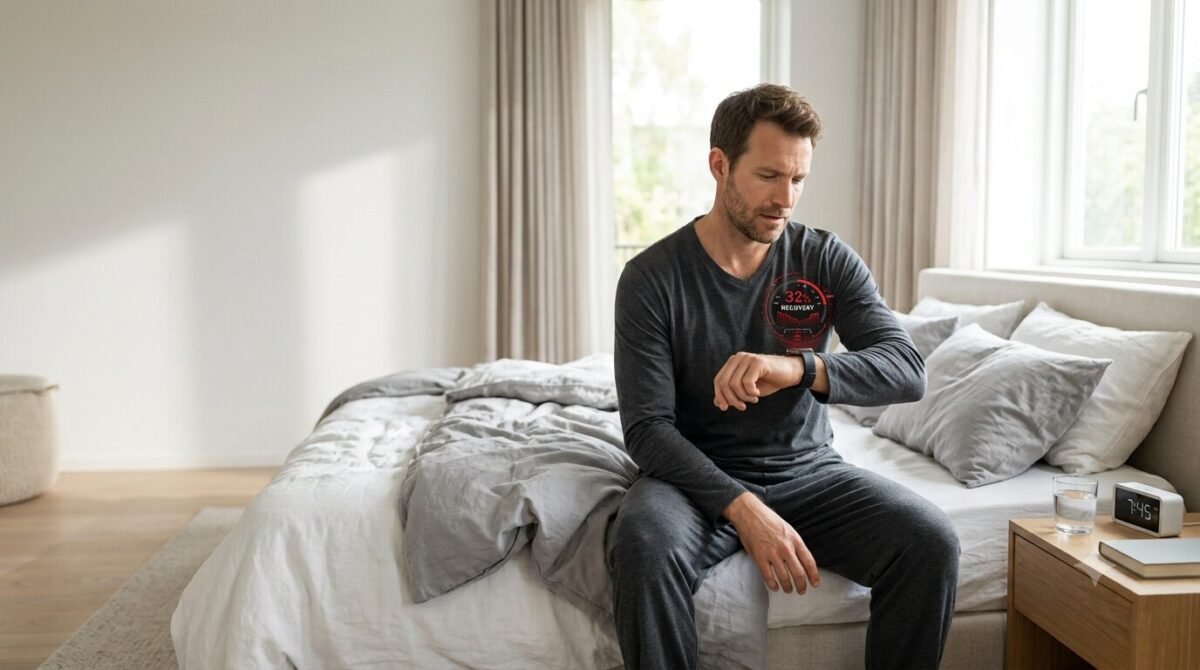
Waking up to a low recovery score can be frustrating when you believe you slept well. You may have gone to bed on time, slept for seven or eight hours and avoided a hard evening workout yet your watch or ring still displays a red, yellow or “pay attention” result.
The reason is simple: sleep duration is only one part of most recovery calculations.
Depending on the device, your score may also reflect heart rate variability, resting heart rate, recent activity, sleep regularity, body temperature, respiratory rate and changes from your personal baseline. Different manufacturers use different measurements, time periods and formulas, so two devices can interpret the same night differently.
This guide explains why your score may remain low, how much confidence to place in it and how to decide whether you should train, recover or simply collect more data.
A fitness tracker recovery score can be low after good sleep because the score usually considers more than total sleep time. A lower-than-usual HRV, elevated resting heart rate, recent exercise, emotional stress, alcohol, illness, irregular sleep timing, sensor errors or changes in the device’s algorithm may all affect the result. Focus on your personal trend rather than one reading.
- What does a recovery score measure?
- Why your score can be low after good sleep
- How accurate are recovery scores?
- One low score versus a persistent trend
- Should you exercise with a low score?
- Seven-day troubleshooting plan
- Common mistakes
- When to speak with a healthcare professional
- Wearable data and sleep anxiety
What Does a Fitness Tracker Recovery Score Measure?
A recovery or readiness score is a simplified estimate created from several measurements recorded by a wearable device.
It is not a direct measurement of how “recovered” every part of your body is. Instead, the device combines selected signals and compares them with its own algorithm and, in many cases, your previous data.
Common inputs may include:
- Heart rate variability
- Resting heart rate
- Sleep duration
- Sleep consistency
- Recent physical activity
- Respiratory rate
- Skin or wrist temperature
- Blood oxygen estimates
- Previous recovery trends
The exact inputs vary by brand. For example, Oura considers short- and long-term sleep, activity and body-signal trends, while Garmin’s Body Battery uses HRV, stress, sleep and activity information. WHOOP lists HRV, resting heart rate, respiratory rate, sleep, skin temperature and other measurements among its recovery inputs.
This is why a high Sleep Score does not always produce a high Recovery Score.
Why Is Your Recovery Score Low After Good Sleep?
1. Your HRV Was Below Your Personal Baseline
Heart rate variability is the changing amount of time between successive heartbeats. Many wearables use overnight HRV as one sign of how the autonomic nervous system is responding to physical and psychological demands.
The important comparison is usually not your HRV against another person’s. It is how your recent reading compares with your own normal pattern.
A lower reading may appear after:
- Hard exercise
- Emotional pressure
- Travel
- Alcohol
- Poor sleep timing
- Early illness
- A major change in routine
HRV should not be interpreted alone. A 2025 study in experienced cyclists found that combining HRV with resting heart rate and subjective well-being produced a more nuanced readiness assessment than using HRV by itself.
2. Your Resting Heart Rate Was Higher Than Usual
A tracker may reduce your recovery score when your overnight resting heart rate remains above your normal level.
Possible explanations include:
- Recent strenuous exercise
- Emotional stress
- Alcohol consumption
- Illness
- Heat exposure
- Interrupted sleep
- A late heavy meal
- Changes in medication or routine
A higher reading does not identify the cause. It simply gives you another signal to compare with your recent pattern and how you feel.
3. Your Previous Workout Is Still Affecting You
A full night of sleep does not guarantee that you have fully adapted to a difficult training session.
Long runs, high-intensity intervals, heavy strength sessions and unfamiliar exercises can create different forms of fatigue. A wearable may notice changes in cardiovascular or autonomic measurements, but it may not fully capture muscular soreness, local muscle fatigue, coordination or reduced movement quality.
This explains why you can have:
- A low score without much soreness
- Significant soreness with a normal score
- A low cardiovascular strain score after demanding strength training
- A good readiness score but poor movement quality
Your warm-up, coordination, motivation and performance should therefore be considered alongside the device.
4. Psychological Stress Is Affecting Your Physiology
Your body does not separate work stress from exercise stress as neatly as an app may suggest.
Deadlines, relationship difficulties, financial worries, travel and emotional strain may influence heart rate and HRV even when you spend enough time in bed. The device may detect physiological strain that is not directly related to exercise.
You may also sleep for eight hours without experiencing eight hours of calm, uninterrupted recovery.
5. Alcohol Changed Your Overnight Measurements
Alcohol can affect sleep-related cardiovascular regulation even when you fall asleep quickly or remain in bed for a normal number of hours.
Laboratory and large real-world studies have associated evening alcohol intake with a higher nocturnal heart rate and lower HRV. The size of the change varies by person, timing and amount consumed.
Your tracker may therefore show:
- Adequate sleep duration
- A higher resting heart rate
- Lower HRV
- A reduced recovery score
This is one reason that “I slept for eight hours” and “my body showed normal overnight recovery signals” are not always the same thing.
6. Hydration or Nutrition May Be Inadequate
Heavy sweating, travel, illness and inadequate fluid intake may affect cardiovascular strain and overnight measurements.
However, the relationship between hydration and wearable recovery is not perfectly consistent. Recent studies have reported different results depending on the population, degree of dehydration, exercise protocol and measurement method.
Similarly, eating too little for your training demands may leave you feeling depleted even after a full night in bed.
Review:
- Total food intake
- Carbohydrate availability around demanding exercise
- Regular protein intake
- Fluid intake
- Excessive calorie restriction
- Long gaps between meals
- Recent vomiting, diarrhoea or heavy sweating
Avoid assuming that one supplement will fix a low score. Recovery depends on the broader pattern.
7. Your Body May Be Responding to Illness or Another Stressor
Some wearables consider unusual changes in temperature, respiratory rate, HRV or resting heart rate.
These changes may appear when the body is dealing with an infection or another physiological stressor. However, a consumer wearable cannot determine the exact cause and should not be used to diagnose illness.
The FDA distinguishes general wellness functions from software intended for diagnosing, treating or preventing disease. A wellness score should therefore be treated as supportive information not a medical conclusion.
8. Your Sleep Was Long but Not Consistent
Total sleep duration is only one sleep measurement.
A late bedtime, repeated awakenings, a changing sleep schedule or sleeping at an unusual time may affect how the device evaluates recovery. Some algorithms compare your recent sleep timing and consistency with longer-term patterns.
You may therefore record eight hours of sleep but still differ significantly from your usual routine.
9. The Device Collected Imperfect Data
Wearables estimate physiological signals using sensors that can be affected by:
- Loose or overly tight fit
- Poor skin contact
- Sleeping on the device
- Movement
- Tattoos or other factors affecting optical readings
- Low battery
- Missing data
- Switching wrists or fingers
- A new device
- Incorrect personal settings
Before changing your training plan, confirm that the device was worn correctly and collected a complete night of data.
10. The Algorithm or Baseline Changed
Different manufacturers do not calculate recovery in the same way. Even within one brand, software updates, new sensors or recalculated baselines may change how results are presented.
A 2025 evaluation found substantial differences among wearable composite scores in their inputs, averaging periods and metric weighting. Exact formulas were not publicly disclosed by the manufacturers examined.
If your score changes suddenly without any clear lifestyle change, check:
- Whether the app was updated
- Whether the device firmware changed
- Whether you changed devices
- Whether your baseline was recalculated
- Whether the app added a new metric
- Whether data was missing during recent nights
Common Causes and Practical Next Steps
| Possible Reason | What You May Notice | Practical Next Step |
|---|---|---|
| HRV below baseline | Low score despite normal sleep duration | Review several nights instead of one |
| Elevated resting heart rate | Higher overnight pulse than usual | Consider recent training, alcohol, stress or illness |
| Heavy training | Fatigue or reduced performance | Reduce intensity or volume temporarily |
| Emotional stress | Normal sleep time but poor readiness | Add recovery time and stress-management habits |
| Alcohol | Higher heart rate and lower HRV | Compare alcohol-free and drinking nights |
| Inadequate food or fluids | Low energy, thirst or poor training quality | Restore regular meals and hydration |
| Sensor problem | Missing or unusual data | Clean, reposition and correctly fit the device |
| Algorithm update | Sudden score shift without lifestyle change | Check software and baseline updates |
How Accurate Are Recovery Scores?
Recovery scores can be useful for identifying patterns, but they are not direct clinical measurements.
The sensors themselves may measure some variables reasonably well under particular conditions. However, the final readiness score adds another layer: the manufacturer decides which inputs to include, how to weight them and how to translate them into a colour or number.
Sleep tracking provides a helpful example. In a 2024 comparison with laboratory polysomnography, three popular devices detected sleep versus wake with high sensitivity, but their performance varied more when distinguishing specific sleep stages. The study involved healthy adults over one laboratory night, so its results should not automatically be applied to every user or sleep disorder.
Use your tracker for:
- Personal trends
- Recognizing repeated patterns
- Reviewing the effects of routines
- Starting useful conversations with a professional
Do not use it alone for:
- Diagnosing illness
- Deciding whether symptoms are harmless
- Changing medication
- Proving that you are safe to perform intense exercise
- Comparing your health directly with another person
One Low Score Versus a Persistent Trend
| Pattern | Possible Interpretation | Suggested Response |
|---|---|---|
| One low score, no symptoms | Normal daily variation or imperfect data | Continue observing |
| Low score after hard training | Temporary training-related strain | Consider lighter activity |
| Low score after alcohol or travel | Short-term lifestyle effect | Return to normal routine and observe |
| Several low scores with obvious stress | Recovery demands may be elevated | Reduce avoidable stress and training load |
| Persistent low trend without clear cause | Requires closer review | Check device quality and discuss concerns if needed |
| Low trend with concerning symptoms | Wearable data is secondary to symptoms | Seek professional medical advice |
Should You Exercise With a Low Recovery Score?
A low score does not automatically mean that you must avoid all movement.
Consider three things together:
- The score and its underlying measurements
- How you feel
- How you perform during a gentle warm-up
You may consider normal or moderately adjusted training when:
- The low reading is isolated
- You feel well
- Your warm-up feels normal
- Movement quality is good
- There are no concerning symptoms
- Recent training load has been manageable
Consider reducing intensity or choosing active recovery when:
- Several measurements are outside your normal range
- You feel unusually tired
- Coordination or movement quality is poor
- Your warm-up feels much harder than usual
- You have significant soreness after an unfamiliar session
- Several low-score days appear together
Avoid relying on a green score when:
- You feel unwell
- You have pain that changes your movement
- You are dizzy or unusually short of breath
- You have signs of acute illness
- Your performance is clearly impaired
The score can inform the decision, but it should not make the decision by itself.
A Seven-Day Recovery-Score Troubleshooting Plan
Day 1: Check the Device
Confirm correct placement, sensor cleanliness, battery level and complete data collection.
Day 2: Review Your Personal Baseline
Compare HRV, resting heart rate and sleep timing with your own recent trend not someone else’s score.
Day 3: Review Training Load
Look at your previous three to seven days rather than only yesterday’s workout.
Day 4: Review Alcohol, Meals and Hydration
Note late alcohol, unusually heavy meals, inadequate food intake and heavy sweating.
Day 5: Review Emotional and Environmental Stress
Include work pressure, travel, heat, altitude and major changes in routine.
Day 6: Compare the Score With Your Body
Record soreness, energy, mood, motivation, coordination and warm-up performance.
Day 7: Look for a Pattern
Ask:
- Is the score improving?
- Is one metric repeatedly driving it down?
- Does it follow hard training or alcohol?
- Did the device update?
- Are symptoms present?
- Is tracking the score increasing anxiety?
A seven-day review is not a medical test. It is a practical way to avoid reacting emotionally to one morning’s number.
Practical Tips for More Useful Recovery Data
- Wear the device consistently in the recommended position.
- Compare results with your own baseline.
- Review weekly trends rather than chasing perfect daily scores.
- Maintain regular sleep and wake times.
- Match training volume to your recovery capacity.
- Eat enough to support your activity.
- Limit alcohol when recovery matters.
- Include easier training days.
- Record subjective factors such as energy, mood and soreness.
- Step away from the app temporarily if checking it increases anxiety.
Common Mistakes to Avoid
- Treating every red score as a medical warning
- Assuming a green score makes intense exercise automatically safe
- Comparing your HRV with a friend’s
- Trying to “hack” the score with unnecessary supplements
- Ignoring symptoms because the score looks good
- Changing several habits at once and not knowing what helped
- Believing wearable sleep stages are identical to laboratory measurements
- Checking the app repeatedly throughout the day
How Wearable Data Can Increase Sleep Anxiety
Some people become so focused on achieving ideal sleep numbers that tracking begins to increase worry rather than provide useful guidance.
The term orthosomnia has been used in sleep research to describe an excessive focus on improving wearable sleep data. It was initially discussed through clinical case reports, and later cross-sectional research found that the pattern may affect a subset of sleep-tracker users. These findings do not prove that trackers cause insomnia, but they support paying attention to how the data affects your thoughts and behaviour.
Consider taking a break from detailed sleep or recovery scores when:
- You feel anxious before opening the app
- A low score changes how you feel despite feeling well
- You repeatedly extend time in bed to chase a higher score
- You avoid normal activity because of the number
- Tracking makes it harder to sleep
When to Speak With a Healthcare Professional
A low score alone does not diagnose a medical condition.
Consider speaking with a qualified healthcare professional when:
- Unusual readings persist without an obvious reason
- Your resting heart rate changes significantly from your normal pattern
- The low readings are accompanied by persistent fatigue or other symptoms
- You have concerns about heart rhythm, breathing or sleep
- You are using the score to manage an existing medical condition
- Anxiety about the data is affecting daily life or sleep
Do not stop or change prescribed medication because of a wearable reading.
12. FAQs
Is one low recovery score a reason to worry?
Usually, one low score is more useful as an observation than as a warning. Daily readings can change because of training, stress, alcohol, travel, imperfect sensor contact or normal variation. Review the underlying metrics and your physical condition, then watch what happens over the following nights.
Why is my HRV low when I feel fine?
HRV can vary even when your mood and energy feel normal. It may reflect recent training, psychological stress, alcohol, travel, illness or normal day-to-day changes. Your personal trend is usually more meaningful than one reading or a comparison with another person.
Can stress lower my recovery score after good sleep?
Yes. Emotional stress may influence heart rate and HRV even if you spend enough time asleep. Work pressure, relationship strain, travel and major life events can affect the autonomic nervous system and may be reflected in overnight measurements.
Should I exercise when my tracker shows a red score?
Do not use the colour alone. Consider whether the score is isolated or persistent, how you feel and how your warm-up goes. Light movement may be reasonable when you feel well, while unusual fatigue, illness or impaired movement may justify rest or reduced training.
Can a software update change my recovery score?
It can. Software, firmware, sensor and baseline updates may change how data is collected or interpreted. When your score changes suddenly without a clear change in sleep, training or lifestyle, check the app’s update history and confirm that your baseline has not been recalculated.
Are fitness tracker sleep stages accurate?
Consumer devices can provide useful sleep estimates, but accuracy varies by device, measurement and user. Research suggests that sleep-versus-wake detection can be reasonably strong in healthy adults, while individual sleep-stage estimates remain more variable than laboratory polysomnography.
Can dehydration cause a low recovery score?
Possibly, especially after heavy sweating or inadequate fluid intake, but research findings are not completely consistent. Hydration may influence heart rate and autonomic measurements, although the effect depends on the degree of dehydration, exercise conditions and individual response.
Does muscle soreness lower a recovery score?
Not necessarily. Some recovery scores focus heavily on cardiovascular and autonomic measurements rather than direct muscle damage. You can be sore with a normal score or have a low score without much soreness. Consider muscular fatigue and movement quality separately.
Can genetics cause a naturally low recovery score?
Genetic and biological differences may contribute to individual HRV and cardiovascular patterns, but a consumer recovery score cannot diagnose a genetic cause. Current evidence does not support routine DNA testing simply because a tracker repeatedly displays a low score.
13. Conclusion
A low fitness tracker recovery score after good sleep does not necessarily mean that you slept badly or that something is wrong.
Sleep duration is only one input. HRV, resting heart rate, recent exercise, stress, alcohol, nutrition, illness, sensor quality and the device’s algorithm may all contribute.
Use the score as a clue rather than a verdict. Look at several days of data, compare measurements with your personal baseline and consider how your body feels and performs.
Explore more Health Fitnesses guides on muscle recovery, healthy sleep, stress management and active recovery to build a balanced routine that supports both performance and long-term well-being.