
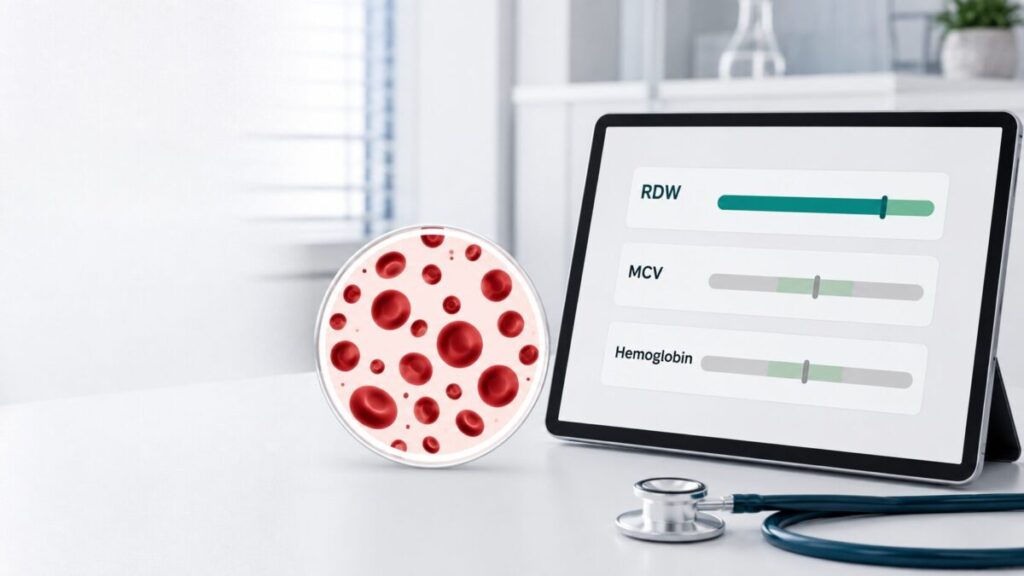
Seeing a high RDW flag next to normal MCV and normal hemoglobin can feel contradictory. It is not. RDW and MCV describe different features of your red blood cells: RDW reflects how much their sizes vary, while MCV is only the average cell size. A mixture of smaller and larger cells can therefore produce a normal average even though the size spread is wider than your laboratory expects. Normal hemoglobin also means that anemia is not established by that value alone; it does not identify the reason RDW is elevated. This pattern can occur with early iron depletion, vitamin B12 or folate problems, mixed deficiencies, recent blood loss or recovery, transfusion, inflammation, and other situations. The useful next step is to interpret the complete CBC, the trend over time, symptoms, and targeted follow-up tests rather than treating RDW as a diagnosis.
| Quick Answer High RDW with normal MCV and normal hemoglobin means your red cells vary in size more than expected even though their average size and hemoglobin value remain within range. It can be seen in early or mixed deficiencies, during recovery from blood loss, after transfusion, or with other conditions. RDW alone cannot identify the cause; the rest of the CBC and selected follow-up tests provide the context. |
What Does RDW Actually Measure?
Red cell distribution width is part of a complete blood count. It describes how much red-blood-cell size varies within the sample. A higher RDW means the population is less uniform. MedlinePlus emphasizes that RDW is not enough to make a diagnosis by itself and is normally interpreted with other red-cell indices and the clinical picture.
This distinction matters because “high RDW” is a description of cell-size variation, not a disease name. The underlying reason may be nutritional, related to blood-cell turnover, linked to recent treatment or transfusion, or unrelated to a nutrient deficiency altogether.
RDW-CV vs RDW-SD: Check the Units First
Laboratories can report RDW in more than one form. The reports you supplied highlight RDW-CV, usually shown as a percentage, and RDW-SD, generally shown in femtoliters (fL). They are related but are not interchangeable, so a value should always be compared with the reference range printed beside that specific test.
| Feature | RDW-CV | RDW-SD |
| Typical unit | % | fL |
| What it expresses | Variation relative to average cell size | Width of the red-cell size distribution |
| Relationship to MCV | Mathematically influenced by MCV | Less dependent on the mean |
| Best practice | Use the laboratory’s RDW-CV range | Use the laboratory’s RDW-SD range |
| Reference-range rule Do not compare your RDW with a universal internet cutoff. MedlinePlus notes that reference ranges can vary by laboratory. Use the range and units on your own report. |
Why Can RDW Be High When MCV Is Normal?
MCV is an average. An average can conceal a mixed population. NCBI’s Clinical Methods explains that MCV may remain normal when two different red-cell populations are present, while RDW or the red-cell histogram can reveal the increased variation.
A simple worked example
Imagine one group of red cells is smaller than usual and another group is larger than usual. If the two groups balance each other, their average volume can land inside the normal MCV range. RDW can still be elevated because the cells are spread across a wider range of sizes. This is why a normal MCV does not automatically mean every red cell is normal-sized.
Why Can Hemoglobin Still Be Normal?
Hemoglobin measures a different part of the picture. A normal hemoglobin result means the value has not crossed your laboratory’s threshold for anemia. It does not prove that iron stores, vitamin B12 status, folate status, or red-cell production are all normal. Iron deficiency, for example, can exist before anemia develops, so clinicians use iron-status testing rather than hemoglobin or RDW alone when the history suggests possible deficiency.
Possible Reasons for High RDW With Normal MCV and Hemoglobin
The pattern has more than one possible explanation. The most useful approach is to look for supporting clues rather than rank a diagnosis from RDW alone.
1. Early iron deficiency or depleted iron stores
Iron deficiency can develop before hemoglobin becomes low. Classic hematology references also describe RDW as a value that may increase early in iron deficiency, before obvious microcytosis or anemia is present. However, RDW is not sufficiently specific to diagnose iron deficiency. Ferritin and, when appropriate, a fuller iron panel are more informative.
2. Vitamin B12 or folate-related changes
Vitamin B12 or folate deficiency often affects red-cell size, but a normal MCV does not always exclude B12 deficiency. NICE guidance notes that MCV can remain normal when another process, such as iron deficiency, is present at the same time. Symptoms, diet, medication history, absorption risks, and appropriate laboratory testing matter more than the MCV alone.
3. Mixed nutritional deficiencies
A mixed pattern is one of the clearest reasons RDW and MCV can appear to disagree. A process pushing cells smaller can coexist with one pushing cells larger. The average may look normal while RDW increases because the population is heterogeneous. This is a reason to avoid assuming that normal MCV rules out both iron and B-vitamin problems.
4. Recent blood loss, reticulocytes, or recovery
After blood loss or during recovery from anemia, the marrow may release more young red cells. Reticulocytes are generally larger than mature red cells, so a changing mix of cell ages can widen the size distribution. The timing of bleeding, surgery, illness, or recent treatment therefore matters when interpreting an RDW trend.
5. Recent blood transfusion
Transfused donor cells may differ in size from the recipient’s circulating cells. NCBI Clinical Methods uses recent transfusion as an example of a dimorphic red-cell population. A recent transfusion can therefore make RDW harder to interpret as a marker of the recipient’s baseline cell production.
6. Inflammation, liver disease, kidney disease, or other hematologic conditions
The supplied reports also associate elevated RDW with chronic inflammation, liver disease, kidney disease, hemolysis, and some bone-marrow disorders. These associations are nonspecific. The presence of other CBC abnormalities, symptoms, medical history, and trends determines whether any of these possibilities deserves further evaluation.
RDW + MCV + Hemoglobin: Pattern Guide
| RDW | MCV | Hemoglobin | What the pattern may suggest |
| High | Normal | Normal | Early change, mixed cell populations, recovery, transfusion, or another nonspecific process; confirm context. |
| High | Low | Low | Iron deficiency is one possibility, but other microcytic causes remain in the differential. |
| High | High | Low or normal | B12/folate deficiency, liver-related macrocytosis, reticulocytosis, or other macrocytic processes may be considered. |
| Normal | Low | Variable | A uniform microcytic pattern such as thalassemia trait may be considered alongside iron studies and history. |
| High | Any | Normal | RDW alone does not diagnose anemia; look at the trend and companion tests. |
This table is a pattern guide, not a diagnostic chart. Different laboratories, ages, medical conditions, pregnancy, recent transfusion, and treatment can change interpretation.
How Ferritin and the Iron Panel Change the Interpretation
If iron deficiency is plausible, ferritin is commonly used to assess iron stores. A complete iron assessment may also include transferrin saturation or related markers depending on the clinical situation. This is especially useful when hemoglobin is still normal, because iron deficiency can exist before anemia is established.
| Related HealthFitneses guide For a deeper iron-panel pattern, internally link this section to: “Low Transferrin Saturation With Normal Ferritin: Causes, Iron Test Patterns, and Next Steps.” Add the live URL only after confirming the published page. |
What Tests Might a Clinician Review Next?
There is no universal test bundle for isolated high RDW. The next step depends on the rest of the CBC, symptoms, diet, bleeding history, medicines, pregnancy status, recent illness, and previous results. Depending on that context, a clinician may consider:
- Repeat CBC: useful when the abnormality is unexpected or when a trend matters.
- Ferritin and iron studies: help assess iron stores and available iron when deficiency is plausible.
- Vitamin B12 and folate: considered when dietary, absorption, neurologic, or macrocytic clues exist.
- Reticulocyte count: helps assess bone-marrow response, particularly after blood loss or suspected hemolysis.
- Peripheral blood smear: can show whether red cells truly have mixed sizes or other morphologic abnormalities.
- Kidney, liver, thyroid, or inflammation testing: selected only when the history or other laboratory findings point in those directions.
A bone-marrow examination is not a routine response to one isolated RDW flag. More specialized testing is reserved for situations where the overall blood count, smear, symptoms, or clinical history makes it appropriate.
Common Interpretation Mistakes
| Mistake | Better approach |
| Assuming high RDW equals iron deficiency | Confirm iron status and review the complete CBC. |
| Assuming normal MCV rules out B12 or mixed deficiency | Remember that MCV is an average and can be normal in mixed patterns. |
| Using an internet “danger” cutoff | Use the laboratory’s own reference interval and clinical context. |
| Treating the RDW number itself | Identify and address the underlying cause, if one is present. |
| Starting iron, B12, or folate without evidence | Discuss testing and treatment with a qualified clinician. |
| Ignoring transfusion, bleeding, or recovery history | Include recent events when interpreting the trend. |
Practical Tips for Reviewing Your CBC
- Check the units and reference range. Confirm whether your result is RDW-CV (%) or RDW-SD (fL).
- Read the full CBC. Review MCV, hemoglobin, hematocrit, RBC count, and whether white cells or platelets are also abnormal.
- Compare with older results. A stable mild elevation and a rapidly changing pattern are not the same clinical situation.
- Note recent events. Bleeding, surgery, transfusion, infection, pregnancy, or treatment can affect interpretation.
- Bring relevant symptoms and history. Fatigue, heavy menstrual bleeding, digestive symptoms, dietary restriction, numbness/tingling, and medication history can guide targeted testing.
- Avoid self-supplementing from RDW alone. MedlinePlus advises discussing supplements and diet changes with a healthcare provider when blood tests are abnormal.
| Internal-link opportunity to the previous latest lab guide Add a contextual link in this section to “Low Anion Gap With Normal Albumin: Causes, Lab Patterns, and What to Check Next” as another example of why one flagged laboratory value should be interpreted in a complete panel, not in isolation. |
When to Speak With a Healthcare Professional
Arrange medical review if the RDW elevation persists, is increasing, or occurs with other abnormal blood counts or symptoms such as ongoing fatigue, shortness of breath, pallor, dizziness, unexplained weight loss, numbness or tingling, heavy menstrual bleeding, or other possible blood loss. Significant active bleeding, fainting, chest pain, or severe breathing difficulty needs prompt medical assessment regardless of the RDW value.
For an isolated, mildly high RDW with otherwise normal results and no concerning symptoms, the finding is usually interpreted in context rather than treated as an emergency. The appropriate follow-up depends on the individual, not a single percentage.
Evidence Summary: What RDW Can and Cannot Tell You
| RDW can help with | RDW cannot do by itself |
| Show that red-cell sizes are more variable than expected | Diagnose iron deficiency |
| Add context to MCV and other RBC indices | Diagnose vitamin B12 or folate deficiency |
| Reveal heterogeneity when MCV is only an average | Diagnose cancer or a bone-marrow disorder |
| Support a reason to review trends and selected tests | Tell you which supplement to take |
| Help classify blood-count patterns | Define a universal emergency threshold |
Frequently Asked Questions
Can RDW be high when hemoglobin is normal?
Yes. RDW measures variation in red-cell size, while hemoglobin measures the amount of hemoglobin in the blood. A person can therefore have a wider spread of cell sizes before hemoglobin falls below the laboratory range. The pattern is nonspecific and should be interpreted with MCV, iron status, symptoms, and the rest of the CBC.
Why can MCV be normal if RDW is high?
MCV is an average. If some red cells are smaller and others are larger, the average may still fall within range. RDW captures the spread of cell sizes, so it can be high even when the average MCV looks normal.
Does high RDW with normal MCV mean early iron deficiency?
It can, but it does not prove iron deficiency. Early iron depletion is one possible explanation, and classic hematology references describe RDW as a value that may change before obvious microcytosis or anemia. Ferritin and other iron studies are more appropriate for confirming iron status.
Can vitamin B12 deficiency occur with normal MCV?
Yes. A high MCV is a familiar clue to B12 deficiency, but normal MCV does not completely exclude it. NICE guidance notes that MCV may remain normal when another process, such as iron deficiency, coexists. Symptoms and appropriate B12 testing remain important.
Can iron and B12 deficiency happen at the same time?
Yes. Different deficiencies can coexist. One can tend to make red cells smaller while another tends to make them larger, which may leave the average MCV in the normal range while RDW rises. This is one reason a mixed pattern should not be diagnosed from MCV alone.
Should I take iron if my RDW is high?
Not based on RDW alone. High RDW is not specific for iron deficiency, and unnecessary iron can be inappropriate. Discuss the full CBC and, when indicated, ferritin or other iron tests with a healthcare professional before starting or changing supplements.
Does a high RDW mean cancer or a bone-marrow disorder?
No. RDW is nonspecific and can be elevated in many common and temporary situations. Some studies link RDW with chronic diseases, but an elevated RDW by itself does not diagnose cancer or a bone-marrow condition. Other CBC abnormalities, symptoms, smear findings, and clinical history determine whether further evaluation is warranted.
Do I need to fast before an RDW or CBC test?
For RDW and RBC indices alone, MedlinePlus states that no special preparation is necessary. If other blood tests are being drawn at the same time, follow the specific preparation instructions provided by your clinician or laboratory.
Can a recent transfusion or blood loss change RDW?
Yes. A transfusion may introduce red cells with a different size distribution, while blood loss and recovery can change the proportion of young reticulocytes. These events can temporarily alter the red-cell population and should be included in the interpretation.
Should a high RDW be repeated?
Sometimes. Repeat testing may be useful when the result is unexpected, when prior results are unavailable, or when a clinician wants to follow a trend. The timing depends on the rest of the CBC, symptoms, recent treatment or bleeding, and the reason the blood count was ordered.
Conclusion
High RDW with normal MCV and normal hemoglobin is best understood as a pattern of red-cell size variation, not a diagnosis. MCV can remain normal because it is an average, and hemoglobin can remain normal before some deficiencies or blood-cell changes progress to anemia. Early iron depletion, B12/folate problems, mixed deficiencies, blood loss or recovery, transfusion, inflammation, and other conditions may all enter the differential depending on the wider picture.
The practical approach is simple: check the units and laboratory range, review the whole CBC, compare the trend with older results, consider recent events, and use targeted follow-up tests when the history supports them. Avoid treating RDW itself or starting supplements from one flagged value.
If you are reviewing a CBC, save the full report rather than a screenshot of the RDW value alone. Bring your MCV, hemoglobin, hematocrit, RBC count, prior CBCs, medication list, and any relevant symptoms to your healthcare appointment. For more evidence-based laboratory guides, explore the Health Conditions section on HealthFitneses.