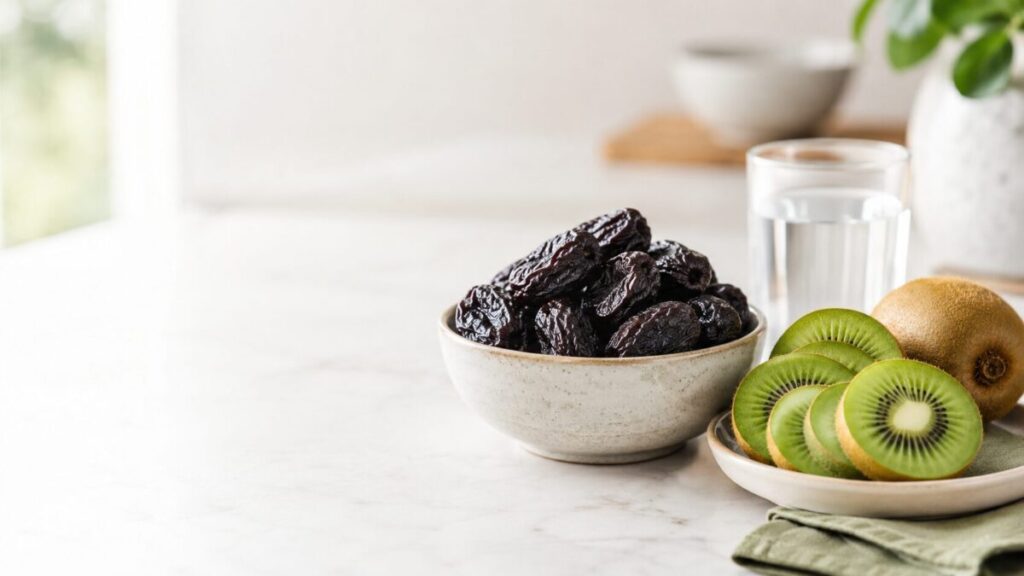
If you want to use food rather than another supplement for constipation, two choices come up repeatedly: prunes and kiwifruit. Both have clinical evidence behind them, but they are not identical. Prunes combine dietary fiber with naturally occurring sorbitol, while green kiwifruit has been studied as a whole fruit in people with functional constipation and IBS-C. The best choice may depend less on finding a single “strongest” fruit and more on what matters to you: bowel-movement frequency, stool consistency, bloating, taste, availability and tolerance. This guide compares the direct clinical evidence, explains where prunes and kiwi differ, and shows how to interpret current dietary guidance without treating a food as a guaranteed cure.
| Quick Answer Neither prunes nor green kiwifruit is a universal winner. In the main direct trial, responder proportions were similar across treatments. Prunes showed strong stool-frequency results, while kiwi improved several constipation measures and had favorable tolerability. Current BDA guidance includes both foods for adults with chronic constipation. If bloating is a major concern, green kiwi may be easier for some people, but individual response varies. |
Article Contents
- Prunes vs kiwi at a glance
- What the direct head-to-head trial found
- Stool frequency and consistency
- Bloating, gas and IBS-C
- Why prunes may help
- How kiwi may help
- Green vs gold kiwi
- Whole prunes vs prune juice
- Practical decision guide
- Limitations and common mistakes
- Practical tips
- When medical review is appropriate
Prunes vs Kiwi at a Glance
| Comparison point | Prunes | Green kiwifruit |
| Clinical evidence for constipation | Yes; trials support stool frequency and consistency | Yes; direct and multicenter trials support bowel movements and GI comfort |
| Distinctive feature | Contains fiber plus naturally occurring sorbitol | Whole-fruit evidence; benefit is not dependent on sorbitol |
| Bloating/tolerance | May cause bloating or gas in some people | Favorable tolerability in the 2021 direct comparison |
| IBS-C context | Sorbitol/FODMAP sensitivity may matter | Studied in IBS-C populations |
| Best-studied form | Whole prunes; prune juice also has separate evidence | Green kiwifruit |
| Current adult guideline example | BDA includes 8–10 prunes daily | BDA includes 2–3 kiwifruits daily |
The guideline amounts above come from the 2025 BDA adult chronic-constipation guidance. They are evidence-based population recommendations, not a personal prescription. Individual needs, medical conditions, allergies and tolerance can change what is appropriate.
What Did the Direct Head-to-Head Trial Find?
The most useful study for this exact comparison is a 2021 American Journal of Gastroenterology trial that assigned adults with chronic constipation to two green kiwifruits per day, 100 g of prunes per day, or 12 g of psyllium per day for four weeks. Seventy-nine people entered the study and complete data were available for 75 participants.
The key point is easy to miss when reading secondary headlines: the proportions of participants meeting the study’s primary responder definition were similar between the three treatments. In other words, the trial did not establish prunes as a statistically proven overall winner over kiwi. All three treatments increased weekly complete spontaneous bowel movements, while kiwi and prunes both improved stool consistency. Kiwi also improved bloating scores and had the lowest adverse-event and dissatisfaction rates in that study.
| Do not confuse “numerically higher” with “proven better” A group can have a higher percentage or larger numerical change without the between-group difference being statistically persuasive. For this topic, the safest conclusion is that both foods helped, while their strengths and tolerability profiles differed. |
Which Is Better for Stool Frequency?
Prunes have a strong case when stool frequency is the main priority. In the direct 2021 comparison, the prune group showed a strong numerical improvement in bowel-movement frequency. Separate evidence also supports prunes: a 2011 randomized crossover trial found dried plums improved complete spontaneous bowel movements and stool consistency more than psyllium in people with mild to moderate constipation.
Green kiwi also has meaningful evidence. A 2023 international multicenter crossover trial in New Zealand, Japan and Italy found that two green kiwifruits daily produced clinically relevant increases in complete spontaneous bowel movements in people with functional constipation and IBS-C, alongside improved gastrointestinal comfort. That study compared kiwi with psyllium rather than prunes, so it supports kiwi effectiveness but does not prove superiority over prunes.
Which Is Better for Stool Consistency?
Both foods have evidence for improving stool consistency. In the 2021 direct comparison, stool consistency improved significantly from baseline with both kiwi and prunes. Older prune research also found improvements in stool form, and a 2022 randomized placebo-controlled prune-juice trial reported fewer hard and lumpy stools and more normal stools during the intervention.
For a reader with hard stools, this means both foods are reasonable evidence-based candidates. The better personal choice may come down to gastrointestinal tolerance and practicality rather than a clear scientific winner for stool form.
Which Is Better for Bloating and Gas?
Green kiwi has the more favorable signal in the main direct trial. Participants assigned to kiwi reported improvement in bloating, and the kiwi group had the lowest overall adverse-event and dissatisfaction rates. That does not mean kiwi will never cause symptoms, but it makes tolerability a legitimate reason to consider it.
Prunes naturally contain sorbitol, a poorly absorbed sugar alcohol that can draw water into the bowel. That can contribute to laxation, but in sensitive people it can also contribute to gas, bloating or looser stools. American College of Gastroenterology commentary specifically notes this tradeoff when discussing prunes for people with IBS symptoms.
Prunes vs Kiwi for IBS-C
IBS with constipation is not just “constipation plus a little pain.” Abdominal pain and sensitivity can make tolerability especially important. Green kiwi has been directly studied in IBS-C populations, including the 2023 international trial. Prunes may still be useful, but their sorbitol content means some people with IBS may find them harder to tolerate.
If you have IBS-C, avoid turning a general food comparison into a rigid rule. Portion size, other FODMAP-containing foods eaten at the same time, baseline symptoms and your personal tolerance all matter. A dietitian familiar with gastrointestinal disorders can help if dietary restriction is becoming complicated.
Why Do Prunes Help Constipation?
Prunes likely work through more than one feature. They provide dietary fiber, and they also contain sorbitol. Sorbitol is incompletely absorbed in the small intestine, so it can increase the amount of water remaining in the intestinal contents. Prunes also contain plant compounds such as polyphenols, but it is more cautious to view those as possible contributors rather than proven stand-alone laxative mechanisms.
This combination helps explain an important practical point: the same components that make prunes effective may also make them more likely to cause bloating or loose stools when the amount is more than an individual tolerates comfortably.
How May Kiwifruit Help Constipation?
Green kiwifruit provides dietary fiber within a fruit structure that can hold water and swell. Laboratory and clinical commentary suggest these physical properties may help increase water retention in the intestinal contents and support softer, easier-to-pass stools. Human trials show improved bowel movements and gastrointestinal comfort, but the exact contribution of each mechanism is still being studied.
Does Actinidin Explain the Constipation Benefit?
Actinidin is a protein-digesting enzyme found in green kiwifruit, and laboratory research has shown that it can influence protein digestion. However, that is not the same as proving that actinidin is responsible for treating constipation. The supplied research correctly flags this as an uncertainty. The clinical constipation evidence is stronger for eating the whole fruit than for attributing the effect to one enzyme.
Green vs Gold Kiwi: Does Variety Matter?
Green kiwi is the safest variety to emphasize because it has the strongest and most repeated constipation evidence in the studies used for this article. A smaller randomized crossover trial has also reported improvements with two gold kiwifruits daily, but the gold-kiwi evidence base is more limited. If your goal is to follow the best-studied food intervention, green kiwi is the more evidence-supported choice at present.
Whole Prunes vs Prune Juice
Whole prunes and prune juice should not be treated as nutritionally identical. Whole prunes retain their intact fruit fiber, while prune juice provides a different mix of fiber and soluble components. Importantly, prune juice does have its own randomized placebo-controlled evidence showing improvement in hard stools and constipation complaints.
That evidence means prune juice can be discussed as a separate option, but it does not prove that a glass of juice is equivalent to a studied serving of whole prunes. If your goal is to copy the food intervention used in the direct kiwi-versus-prunes trial, whole prunes are the closer match.
Practical Decision Guide: Which One May Suit You Better?
| Your priority | Food to consider first | Reasonable interpretation |
| You want strong stool-frequency evidence | Prunes | Multiple prune studies support bowel-movement frequency; the direct trial also showed strong numerical results. |
| Bloating is your biggest concern | Green kiwi | Kiwi had favorable bloating and tolerability findings in the direct trial. |
| You have IBS-C or FODMAP sensitivity | Green kiwi may be easier for some | Prune sorbitol can be troublesome for sensitive people; individual tolerance still matters. |
| You prefer a fresh whole fruit | Green kiwi | The 2023 multicenter trial directly studied fresh green kiwifruit. |
| You prefer dried fruit and do well with it | Prunes | Prunes are portable, shelf-stable and have direct constipation evidence. |
| You want a juice option | Prune juice has separate evidence | Do not assume it is identical to whole prunes; treat it as a different intervention. |
What the Research Cannot Tell Us Yet
Most of the food trials are relatively small and short. They do not tell us with certainty which food works best for every age group, every cause of constipation, or long-term daily use. The studies also use specific portions and carefully defined outcomes that may not match everyday eating patterns.
Funding deserves transparency as well. Some kiwi research received support from Zespri, a kiwifruit marketer. Industry funding does not automatically invalidate a trial, but it is one reason to look at study design, independent replication, effect sizes and limitations rather than relying on promotional summaries.
The 2025 BDA guidelines are helpful because they synthesize a much larger evidence base using systematic review and GRADE methods. Even there, certainty varies, reminding us that dietary guidance can be useful without pretending the evidence is perfect.
Common Interpretation Mistakes
| Common mistake | Better interpretation |
| “Prunes had a higher number, so they were proven superior.” | Numerical differences do not automatically equal statistically significant superiority. |
| “Kiwi caused less bloating in one study, so it never causes bloating.” | Tolerance varies; the study gives a useful signal, not a guarantee. |
| “Actinidin is why kiwi cures constipation.” | Whole kiwi has clinical evidence; actinidin is not established as the specific constipation mechanism. |
| “Prune juice and whole prunes are the same intervention.” | Both have evidence, but they differ in food structure and should be discussed separately. |
| “If food does not fix it, just eat more fiber.” | Persistent constipation can have multiple causes and may need medical assessment. |
Practical Tips
- Choose one approach at a time so you can judge tolerance instead of adding several new high-fiber foods on the same day.
- Use the portion on your clinician’s or dietitian’s plan when you have IBS, diabetes, kidney disease, pregnancy, food allergies or another condition that changes dietary needs.
- Current BDA adult guidance includes 2–3 kiwifruits daily or 8–10 prunes daily for chronic constipation, but these are population recommendations rather than a requirement for every reader.
- If you increase fiber-containing foods, pay attention to overall fluid intake and your own medical needs rather than forcing a universal water target.
- Track stool frequency, stool form, bloating and straining for a couple of weeks; “more bowel movements” is not the only outcome that matters.
- If symptoms worsen, stop escalating the amount and seek individualized advice rather than assuming more fruit will work better.
| HealthFitneses related reading For a broader explanation of the fruit itself, link the phrase “how kiwifruit may support digestion” to the HealthFitneses kiwi digestion guide. In the bloating section, link “why bloating happens after eating” to the existing bloating guide. Confirm the final WordPress permalinks before publishing. |
When Constipation Needs Medical Review
Food-based strategies can be reasonable for mild constipation, but they should not delay evaluation when symptoms persist or when warning signs are present. NIDDK advises medical review when constipation does not improve with self-care or becomes long-term.
Seek prompt medical attention if constipation occurs with rectal bleeding or blood in the stool, constant abdominal pain, inability to pass gas, vomiting, fever, unexplained weight loss or another concerning change. These symptoms are not situations for experimenting with increasingly large portions of prunes or kiwi.
| Safety note This article is general education, not personal medical advice. Children, pregnant people, people with known food allergy, significant gastrointestinal disease, diabetes, kidney disease or complex medication regimens may need individualized dietary guidance. |
References
FAQs
Are prunes or kiwi better for constipation?
There is no universal winner. Prunes have strong evidence for stool frequency and stool consistency, while green kiwi also improves bowel movements and had favorable bloating and tolerability findings in the main direct comparison. If bloating or IBS sensitivity is important, green kiwi may be a better starting option for some people.
Did prunes outperform kiwi in the direct clinical trial?
Prunes had stronger numerical response results in some reports, but the 2021 primary trial states that the proportions meeting its main responder endpoint were similar across the treatments. That means it is inaccurate to say the study proved prunes were categorically superior to kiwi.
Why can prunes cause bloating?
Prunes contain sorbitol, a sugar alcohol that is not fully absorbed in the small intestine. Its osmotic effect may help soften stool, but in sensitive people it can also contribute to gas, bloating or loose stools. This is particularly relevant for some people with IBS.
Does green kiwi help constipation?
Yes, green kiwifruit has randomized clinical-trial evidence. A 2023 international multicenter study found clinically relevant increases in complete spontaneous bowel movements and improved gastrointestinal comfort in people with functional constipation and IBS-C.
Is green kiwi better than gold kiwi for constipation?
Green kiwi is better studied for constipation and should be the main variety discussed when following the strongest evidence. Gold kiwi has smaller randomized-trial evidence suggesting benefit, but the overall research base is more limited.
Is actinidin the reason kiwi helps constipation?
That has not been established. Actinidin can influence protein digestion, but evidence about protein digestion does not prove it is the mechanism responsible for improved constipation. The stronger clinical evidence supports eating whole kiwifruit rather than attributing the effect to one enzyme.
Can prune juice replace whole prunes?
Prune juice has its own randomized-trial evidence for improving hard stools and constipation complaints, but it is not nutritionally identical to whole prunes. If you want to reproduce the intervention used in the direct kiwi-versus-prunes trial, whole prunes are the closer match.
How much kiwi or prunes do current guidelines suggest?
The 2025 BDA adult chronic-constipation guidance includes 2–3 kiwifruits daily and 8–10 prunes daily among evidence-based food strategies. These are guideline examples for adults, not universal prescriptions; personal tolerance and medical conditions may require different advice.
When should constipation be checked by a doctor?
Seek medical advice if constipation persists despite self-care or becomes long-term. Prompt evaluation is important when constipation is accompanied by rectal bleeding or blood in the stool, constant abdominal pain, inability to pass gas, vomiting, fever or unexplained weight loss.
Conclusion
Prunes and green kiwifruit are both credible food-based options for constipation, but their strengths are different. Prunes combine fiber and sorbitol and have strong evidence for stool frequency. Green kiwi has replicated evidence for bowel-movement improvement and gastrointestinal comfort, and it produced favorable tolerability results in the main direct comparison.
For most readers, the useful question is not “Which fruit wins?” but “Which evidence-based option fits my symptoms and tolerance?” If bloating is prominent, kiwi may be worth considering. If prunes are easy for you to tolerate and stool frequency is the main concern, they remain a well-supported choice. Persistent or concerning constipation deserves a broader medical assessment rather than an ever-larger food experiment.
Explore more evidence-based Natural Foods and digestive-health guides on HealthFitneses. When this article is published, link the call to action to the Natural Foods category and add the final canonical article URL to the LinkedIn newsletter package.